🚨 “She Took Our Child and Won’t Tell Me Where They Are” — What Florida Parents Can (and Can’t) Do

Florida Family Law

🚨 “She Took Our Child and Won’t Tell Me Where They Are” — What Florida Parents Can (and Can’t) Do

If your child’s other parent has taken them and won’t share their location—and you don’t have a court order—here’s what you need to know about your legal options in Florida.


“She Took Our Child and Won’t Tell Me Where They Are” — Now What?

This is one of the most terrifying messages we receive:
“The other parent took our child and won’t tell me where they are. What can I do?”
It feels like kidnapping. It feels wrong. And emotionally, it is. But legally? If you don’t have a court-ordered parenting plan, the hands of law enforcement—and the courts—may be tied. Let’s walk through what’s real, what’s possible, and what to do next if you’re in this situation in Florida.

❌ Why Police Often Can’t Help

If there is no existing court order that outlines custody, time-sharing, or parental responsibility, then both parents have equal rights to the child under Florida law. That means:
  • The police cannot enforce a verbal agreement.
  • You cannot get a “pick-up order” without a court order already in place.
  • It’s not considered a crime unless there’s a safety threat or someone is violating a court directive.

✅ What You Can Do Legally

1. File a Petition Immediately

You’ll need to formally file a case in court. This could be: You can—and probably should—file an emergency motion at the same time asking the court to:
  • Establish temporary timesharing
  • Prevent the other parent from removing or withholding the child
  • Order them to disclose the child’s location
📝 Tip: The court will only treat it as an “emergency” if there’s evidence of imminent harm, flight risk, or serious mental health or substance abuse issues. Otherwise, the motion might just be expedited—not emergency.

2. Consider Contacting DCF

If you are concerned about the child’s safety, but not necessarily able to prove a legal emergency:
  • You can call the Florida Department of Children and Families (DCF)
  • Ask for a well-child check if there’s a concern for abuse, neglect, or abandonment
This is not a guarantee of action, but it can open a protective investigation if warranted.

🚨 When It Is an Emergency

If there is credible evidence that:
  • The child is in danger
  • The other parent is hiding the child across state lines
  • The parent is threatening harm or exhibiting unstable behavior
You should:
  • Contact an attorney immediately
  • File an emergency verified motion with specific facts and supporting documents
  • Include affidavits, screenshots, police reports, or witness statements

🧠 Don’t Let Emotion Drive the Strategy

It’s easy to spiral when you feel powerless. But here’s what we tell our clients:
  • Don’t text threats or lash out on social media
  • Do keep a record of every attempt to contact the other parent
  • Do stay calm, gather proof, and move fast in court
Even though it doesn’t feel fair, the system is designed to protect due process. That means your best move is a strategic legal plan, not emotional retaliation.

⚖️ How We Can Help

At Family Matters Law Group, P.A., we guide parents through: We offer flat fees, strategy sessions, and legal coaching so you don’t have to feel stuck—or broke.

🔗 Internal Calls to Action:


Bottom Line:

If the other parent took your child and there’s no court order in place, the police likely can’t help—but the court can.
File quickly. Document everything. Don’t wait for things to get worse.

#FloridaParentingPlan #ParentTakeChildWithoutPermission #EmergencyCustodyFlorida #NoCourtOrderCustodyFlorida #ChildWithholdingFlorida #DCFChildCheck #FilingPaternityFlorida

Talk it through before you sign anything

Your intake goes straight to our team — start with a free consult or move straight ahead.

When Divorce Threats Get Loud, Stay Grounded in Truth

Florida Family Law

When Divorce Threats Get Loud, Stay Grounded in Truth

Being told “you’ll never see your kids again” or “you’re not getting a dime” during divorce? Learn why these threats are rarely legally valid and how to respond under Florida family law.

Divorce and separation are emotional minefields. Even the most rational people can say irrational things when their world feels like it’s unraveling.

If you’ve received messages like:
“You’ll never see your child again.”“You’re not getting a penny from me.”“This is my house — you have no right to it.”“You’re not entitled to know where we live.”
You’re not alone. These are some of the most common phrases we hear from clients on the receiving end of toxic divorce threats.
But here’s the truth: in Florida, these threats usually mean absolutely nothing legally.

Why People Say These Things

Fear. Control. Anger. Desperation. When someone is going through a major life transition like divorce, especially if they didn’t initiate it or feel blindsided, they may react by trying to control what they can. That often means threatening to take away your rights — your kids, your money, your home — even if they have no actual legal standing to do so. It’s their way of trying to feel powerful in a moment when they feel powerless. They might not even believe what they’re saying — but they say it anyway, hoping you’ll back down. And sadly, sometimes it works.

Why You Shouldn’t Take These Threats at Face Value

Florida is a no-fault divorce state. That means you don’t need to prove wrongdoing (like infidelity) to get divorced, and courts don’t care who “started” the separation.
More importantly:
  • Parenting time is determined by what’s in the best interest of the child — not by who shouts the loudest.
  • Child support and alimony are based on financial need and statutory formulas, not on someone’s opinion of what you “deserve.”
  • You are entitled to your share of marital assets — even if your ex claims it’s “their” house or “their” money.
Threats are not legal strategy. They’re fear tactics.

What To Do When You’re on the Receiving End

Here’s how to protect yourself legally and emotionally:

1. Don’t Take the Bait

It’s tempting to argue or clap back, but that just escalates the situation. Keep your responses brief, factual, and calm — or don’t respond at all.

2. Document Everything

Save text messages, emails, voicemails — anything that contains threats, harassment, or attempts at manipulation. This could be useful in court or with your attorney.

3. Know Your Rights

Most people making threats have no idea what the law actually says. Talk to a Florida family law attorney who can tell you what’s real and what’s noise.

4. Don’t Make Decisions Based on Fear

Don’t agree to an unfair custody schedule or waive your rights just to “keep the peace.” That temporary peace can turn into long-term regret.

5. Work With a Lawyer Who Gets It

You want someone who won’t just recite statutes but understands the psychological warfare that happens in family law. At Family Matters Law Group, we know how to cut through the drama and get to the facts.

This Week Alone, We’ve Heard It All…

We’ve had multiple calls from potential clients in just the past few days who were terrified they’d lose everything — their kids, their financial stability, their homes — because of threats like the ones we’ve listed. Every. Single. One. Of. Them.
Had nothing to worry about legally. The threats were smoke and mirrors. But the emotional impact? That’s real. That’s why we take these calls seriously, and it’s why we’re passionate about helping people separate facts from fear.

💡 Bottom Line

If someone is trying to scare you into silence or submission during a divorce, take a step back. Those threats may feel powerful in the moment — but the law doesn’t back them up. Your rights as a parent, as a spouse, and as a human don’t disappear just because someone is angry or afraid. 👉 Don’t panic. Get informed. And protect yourself — both legally and emotionally.

📞 Ready to talk to someone who actually knows what Florida law says?

Book a strategy session with our team today:
👉 Get Started With Legal Representation
#FloridaDivorceLawyer #ChildCustodyThreats #FamilyLawAttorney #DealingWithDivorceThreats #ParentingPlanIntimidation #ProtectingYourRights #NoFaultDivorceFlorida #FamilyMattersLawGroup

Talk it through before you sign anything

Your intake goes straight to our team — start with a free consult or move straight ahead.

How Judge Procedures Can Make or Break a Relocation Case in Florida

Florida Family Law

How Judge Procedures Can Make or Break a Relocation Case in Florida

Florida law gives you the right to a hearing on temporary relocation within 30 days—but only if you follow the judge’s division-specific procedures. Learn why statutes aren’t enough.

How Judge Procedures Can Make or Break a Relocation Case in Florida When you’re seeking to relocate with your child in Florida, there’s a clear statutory process to follow. But what many people—and even some lawyers—don’t realize is that following the law isn’t always enough.

✅ What the Florida Law Says

Under Florida Statute 61.13001, if you want to relocate more than 50 miles away with your child, you must:
  • File a Petition for Relocation, and
  • If time is of the essence, also file a Motion for Temporary Relocation so that a judge can consider your request before the full trial.
Critically, the statute gives you the right to have your motion heard within 30 days of filing. Sounds simple, right? Not quite.

🚫 Why Following the Statute Isn’t Always Enough

Each judge in Florida has their own division procedures, which spell out how they manage scheduling, motion practice, and hearings. And those procedures matter. For example, in one of our current relocation cases, the judge’s written procedures say that they will only honor the statutory preference for a hearing within 30 days if:
  • You make the request within 3 days of filing the motion
  • You follow the specific method for requesting it (usually via email or online submission)
That’s not in the statute. But it’s real—and enforceable.

🧠 Why This Matters

Imagine this: You file your petition and motion, serve the other side, and wait to schedule the hearing like you would in most other divisions. You miss that 3-day window. Suddenly, the judge won’t expedite your hearing, and your relocation case drags on for months or even a year. It’s not just about what the law says. It’s about how your judge applies it.

⚖️ What You Should Do Instead

  1. Always read the judge’s procedures before filing.
    They’re usually available on the court’s website under the judge’s name.
  2. Make your request quickly.
    If the judge has a short deadline (like 3 days), get your request in fast.
  3. Follow their instructions exactly.
    Some judges want an email. Others want a formal motion. Don’t guess.
  4. Work with an attorney who knows the courtroom landscape.
    Legal knowledge + local experience = the best shot at success.
📞 Need Help Navigating a Florida Relocation Case? At Family Matters Law Group, P.A., we don’t just know the laws—we know the judges, the procedures, and how to move your case forward strategically. 👉 Schedule a consultation today Let’s make sure your relocation request is done right—from the start. 🟣 Bottom Line: In Florida family court, knowing the statute is only half the battle. The other half? Knowing the judge. #FloridaRelocation #FamilyLawTips #ParentingPlanChanges #TemporaryRelocation #StatutoryRights #KnowYourJudge #DivorceStrategy #FloridaFamilyLaw #FamilyMattersLawGroup

Talk it through before you sign anything

Your intake goes straight to our team — start with a free consult or move straight ahead.

💸 5 Times You Might Owe Child Support (Even If You Make Less Money)

Florida Family Law

💸 5 Times You Might Owe Child Support (Even If You Make Less Money)

Florida child support isn’t just about income. Learn five real reasons why you might owe child support even if you make less than your co-parent. Target Keywords: Florida child support, child support guidelines, parenting time, imputed income, underemployed parent, childcare costs

💸 5 Times You Might Owe Child Support (Even If You Make Less Money)

One of the most common misconceptions we hear is: “I make less than my ex — so there’s no way I’ll owe support, right?” Unfortunately, that’s not how child support works in Florida. Our courts use a formula-based guideline that considers both incomes, yes — but also time-sharing (overnights), who pays for childcare or insurance, and even whether one parent is earning up to their potential. Let’s look at 5 real-life scenarios where you might owe support even with a smaller paycheck.

1️⃣ You Have Less Parenting Time

In Florida, time-sharing matters just as much as income. If your co-parent has more overnights, even if they make more money, the court may assign you a support obligation to balance the caregiving load. Example:
  • You earn $2,500/month
  • Your co-parent earns $4,000/month
  • But they have the kids 80% of the time
    ➡️ The child support formula may still say you owe support, because they’re covering more daily expenses.

2️⃣ Your Co-Parent Pays for Childcare or Health Insurance

Another common situation: your co-parent pays for things like:
  • 🍼 Daycare
  • 🩺 Health insurance
  • 💊 Uninsured medical expenses
If they’re covering these expenses and you’re not contributing, the child support calculation will adjust to reflect that — possibly increasing your obligation. Even with lower income, you may owe support to equalize the total cost of care.

3️⃣ You’re Underemployed (or Not Working)

Florida courts don’t just look at what you are earning — they look at what you could be earning. If you’re unemployed, underemployed, or intentionally working below your capacity, the court can impute income to you. That means it will pretend you’re making what someone with your education, skills, and experience should be making. And yes — the court can assign you a support obligation based on that imputed income, even if your actual paycheck is lower than your co-parent’s.

4️⃣ You Agreed to Support in a Prior Case or Settlement

Child support can also be owed due to agreements made in: 📝 Marital settlement agreements ⚖️ Prior judgments 🤝 Mediated parenting plans Unless formally modified by the court, those agreements are enforceable — even if your income has since decreased.

5️⃣ The Guidelines Just Say You Owe It

The Florida child support guidelines (Section 61.30, Florida Statutes) run on a mathematical formula that includes:
  • Each parent’s net income
  • The number of children
  • Number of overnights
  • Medical, dental, and childcare costs
In many cases, the guideline numbers just come out that way — and you may owe child support, even when your co-parent earns more.

🧠 Bottom Line

Child support in Florida is not as simple as who makes more money. You might owe support because:
  • You spend less time with your child
  • Your co-parent is paying for key expenses
  • You’re under-earning
  • You agreed to support previously
  • The formula just says so
💬 Confused? Frustrated? You’re not alone. We help parents every week who find themselves on the wrong side of a support order they didn’t expect. ✅ Need Help? If you’re facing a support order you don’t understand — or want to know whether a modification is possible — we’re here to help. 📲 Schedule a strategy session with our team. 📘 Or join our Free Florida Family Law Education Group for videos, worksheets, and more: 👉 https://diy-legal-by-family-matters-law-group.mn.co #FloridaFamilyLaw #ChildSupportFlorida #CoparentingHelp #ImputedIncome #UnderemployedParent #ParentingPlanTips #SupportModification #UnfairChildSupport #FamilyMattersLawGroup #DIYLegal #FamilyLawExplained #FinancialFairness #SouthFloridaLawyer

Talk it through before you sign anything

Your intake goes straight to our team — start with a free consult or move straight ahead.

Why Divorce Peaks in January and August: Understanding the Seasons of Separation

Florida Family Law

Why Divorce Peaks in January and August: Understanding the Seasons of Separation

Discover why divorce filings peak in January and August, what it means for your legal strategy, and how to prepare with DIY legal support from Family Matters Law Group, P.A.

Why Do So Many Divorces Happen in January and August?

🔍 Keywords: divorce trends, seasonal divorce,
January divorce spike, back-to-school divorce,
Florida divorce lawyer, DIY divorce, family law timing
If you’ve ever felt like everyone around you was suddenly announcing a divorce at the beginning of the year or just before school starts—you’re not imagining it. According to a recent NPR article, family law attorneys and sociologists have long observed that divorce filings tend to spike in January and again in August. But why? Here’s what’s behind these seasonal surges—and what it means if you’re considering ending your marriage in Florida.

🎄 January: New Year, New Life

The weeks after the winter holidays are often emotionally and logistically pivotal. For many people, the holidays serve as a “last attempt”—a chance to reconnect with their spouse, create good memories for the kids, or avoid rocking the boat during a sentimental season. But when the new year rolls in and the same patterns persist, many people feel empowered to act. January brings a sense of a fresh start, resolutions, and change. That’s why it’s known in the legal world as “Divorce Month.” If you’re planning to file in January:
  • Start preparing your financial documents in advance
  • Think through your parenting plan options
  • Consider whether you want to file with or without an attorney
At Family Matters Law Group, P.A., we offer DIY divorce options, document preparation, and legal coaching to help you start strong—even if you’re not ready to commit to full representation yet.

🎒 August: The Back-to-School Breakup

August might seem like an odd time to file for divorce, but it makes perfect sense when you think about parenting and school calendars. Couples with children often wait until summer vacations are over and school resumes to begin the divorce process. August allows for a smoother transition—especially when custody, school zoning, and co-parenting arrangements are involved. Many parents use this window to:
  • File before the holidays start approaching again
  • Secure court orders or agreements before major school events
  • Minimize disruptions for their children during the academic year

🧠 Emotional & Practical Timing

While divorce is never easy, timing matters—not just emotionally, but also legally and logistically. Filing at the “right” time for your family can affect:
  • Financial planning
  • Tax implications
  • Real estate decisions
  • Parenting schedules and holiday timesharing

🧰 How We Can Help—In January, August, or Anytime

At Family Matters Law Group, P.A., we understand that there’s no one-size-fits-all path through divorce. That’s why we offer:
  • Full legal representation for complex or contested cases
  • Flat-fee and unbundled services for specific tasks or hearings
  • DIY Legal Coaching for those who want to manage their own case with expert guidance
  • Online education and parenting plan workshops to help you prepare at your own pace

📅 Thinking of Filing Soon?

If you’re approaching a new season of your life and thinking about divorce, now is the time to get organized. Whether it’s January, August, or anywhere in between—your timing should reflect your needs, not just the calendar.

📌 Ready to explore your options?

Start with a DIY Strategy Session or download our free divorce prep checklist. Visit our DIY Legal Hub: 👉 https://diy-legal-by-family-matters-law-group.mn.co Or if you’re ready to get started with legal representation: 👉 https://matter-intake.com/create/9e20e620-04b7-43b4-a774-03b604bf2b74 Family Matters Law Group, P.A. with DIY Legal Coaching Smart guidance. Real strategy. Legal support when it matters most.

Talk it through before you sign anything

Your intake goes straight to our team — start with a free consult or move straight ahead.

Can a Postnup Save Your Marriage? How Legal Clarity Can Heal Financial Conflict

Florida Family Law

Can a Postnup Save Your Marriage? How Legal Clarity Can Heal Financial Conflict

Learn how a postnuptial agreement can help couples in Florida navigate financial conflict and protect their marriage before divorce becomes the only option.

💬 Money Isn’t the Problem—Conflict Over Money Is

As family law attorneys, we see the same themes over and over: Marriages aren’t usually ending over a single bad moment. They’re unraveling slowly—through years of unspoken resentment, mismatched values, and stress over finances. The most common culprits? 💸 Money. 👶 Children. 🧠 And the anxiety and emotional disconnection that builds when you feel like you’re constantly fighting an uphill battle. If you’re in a marriage where finances are becoming a daily stressor, you’re not alone. Most couples have very different relationships with money. Maybe one of you is a long-term planner and saver, while the other prefers to live in the moment and spend freely. Maybe there are past financial betrayals—maxed-out credit cards, secret loans, gambling, or an unbalanced division of labor. This doesn’t mean your marriage is doomed. But it might mean you need a plan.

🤝 What Is a Postnuptial Agreement?

A postnuptial agreement (or “postnup”) is a legal contract made after you’re already married. It can outline how your finances will be handled moving forward—both together and individually. In Florida, postnuptial agreements are enforceable as long as they are entered into voluntarily, with full financial disclosure and without fraud, coercion, or duress. Unlike a prenuptial agreement (which is made before marriage), a postnup is a tool you can use when things feel uncertain—but you’re not ready to give up. It can include:
  • Division of assets or debts
  • Responsibility for certain bills or expenses
  • Ownership of specific income streams (like businesses, bonuses, or investments)
  • Terms in the event of separation or divorce
  • Provisions for estate planning or remarriage
  • Agreements around financial therapy or support

🧠 When a Postnup Might Be the Right Move

Here are a few real-life situations where a postnup can help preserve a marriage: ✅ You have completely different financial habits You’re the saver; they’re the spender. Every conversation about money ends in an argument or shutdown. A postnup can set clear guidelines for how you’ll handle joint expenses vs. individual purchases. ✅ One spouse has significantly more debt or income Whether it’s student loans, business losses, or a large inheritance, separating the financial risks can protect both of you—and ease the emotional load. ✅ You’ve experienced a financial betrayal Someone took out credit cards without telling the other. Or they drained a shared account. A postnup can help restore trust by putting formal guardrails in place. ✅ You’re in marriage counseling or doing the work Sometimes, the emotional healing is there—but the money side stays chaotic. A postnup brings structure to the conversations your therapist can’t solve alone. ✅ You’re considering separation, but not yet ready A postnup can offer breathing room. By legally disentangling finances, you create space to work on the emotional aspects without panic or uncertainty.

🛠️ What a Postnup Can Actually Do (and What It Can’t)

Let’s be clear: A postnup is not a magic wand. It won’t “fix” a relationship on its own. But it will do this:
  • Make financial expectations transparent
  • Give both people a voice in the money conversation
  • Help you avoid future litigation if you do separate
  • Show a commitment to working through hard things with clarity and respect
What it won’t do:
  • Guarantee emotional intimacy or behavioral change
  • Work if one party is dishonest or hiding assets
  • Replace communication, therapy, or accountability
💡 Real Talk: Sometimes Love Needs Legal Structure It might feel “unromantic” to bring up legal documents in the middle of your marriage. But here’s what we’ve learned after guiding hundreds of families through separation and healing: The opposite of love isn’t hate—it’s fear. And fear often grows in relationships that lack clarity, safety, or mutual respect—especially around money. A postnup can replace that fear with something better: certainty. Certainty about how bills get paid. Certainty about how you’ll protect your individual goals. Certainty that both voices matter. 🗂 Ready to Talk About It? If you’re curious whether a postnuptial agreement is right for your relationship, we’re here to help—without judgment and with total confidentiality. 👩‍⚖️ We offer both legal representation and DIY Legal Coaching through Family Matters Law Group, P.A. 💬 You can book a private strategy session here.
📚 Or, check out our DIY Legal platform for support if you want to draft your own agreement with guidance. you can also download a postnuptial agreement checklist on the app.
✨ You don’t have to choose between love and logic. A postnup can give you both. Let’s make love feel safe again—on paper and in real life.

Talk it through before you sign anything

Your intake goes straight to our team — start with a free consult or move straight ahead.

How to Get a Child’s Passport Without the Other Parent’s Consent in Florida

Florida Family Law

How to Get a Child’s Passport Without the Other Parent’s Consent in Florida

Learn when Florida parents can apply for a child’s passport without the other parent’s consent. Understand the rules for sole custody, shared parental responsibility, parenting plans, and court orders. SEO Keywords: child passport without consent Florida, sole legal custody passport Florida, par…

Can You Get a Child’s Passport Without the Other Parent’s Signature?

If you’re a Florida parent trying to get a passport for your minor child but the other parent is uncooperative, absent, or just plain difficult — you’re not alone. This is one of the most common issues we see inside our DIY Legal community. Here’s the truth: Yes, it’s possible to get a passport without the other parent’s consent — but only in specific situations, and you’ll need the right documents and process. Let’s break it down.


The General Rule: Both Parents Must Consent

Under U.S. law, if your child is under the age of 16, both parents must give written consent for a passport to be issued. This is true whether you’re married, divorced, or were never in a legal relationship. The default rule protects both parents’ rights and ensures no one is taking a child out of the country without proper legal authority. BUT… There are exceptions. And this is where Florida law — and your specific custody situation — comes into play. Exception #1: You Have Sole Parental Responsibility (Legal Custody) If your Florida court order (or an order from another state, if Florida has jurisdiction now) gives you sole parental responsibility — also known as sole legal custody — you may be able to apply directly through passport services without the other parent’s signature. You’ll need to submit:
  • A certified copy of your court order showing sole parental responsibility
  • A completed passport application and required documentation
  • Form DS-3053 or DS-5525 explaining the absence of the other parent (depending on your circumstances)
📝 Important: If your court order doesn’t clearly say “sole parental responsibility” or doesn’t address decision-making about travel/passports, you may still need court intervention. Exception #2: You Have Shared Parental Responsibility, But the Other Parent Is Uncooperative If you share legal custody (which is the default in Florida unless otherwise ordered), and the other parent:
  • Refuses to sign the passport application
  • Can’t be found
  • Has had little or no contact
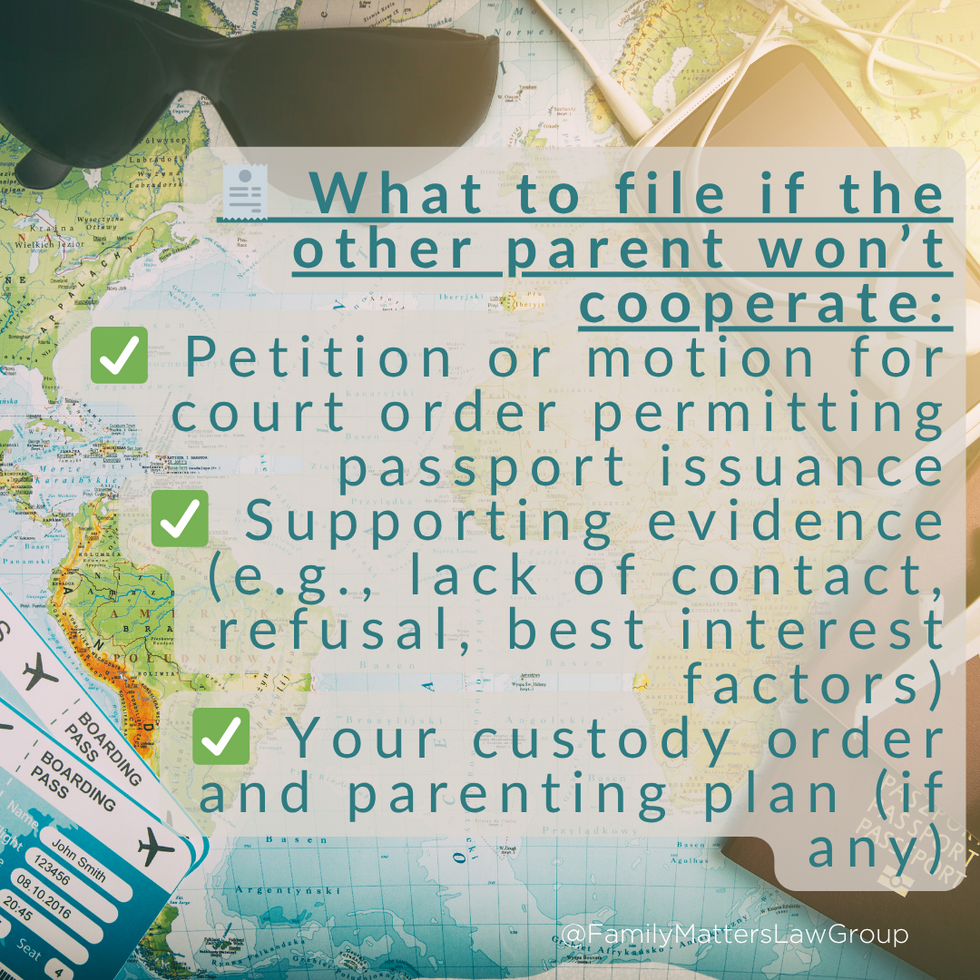
…you can file a motion or petition in Florida family court asking the judge to authorize the passport application without the other parent’s signature. To do this successfully, you’ll usually need to:
  • Show that you made reasonable efforts to contact the other parent (or explain why that’s not possible)
  • Prove that issuing the passport is in the best interest of the child (e.g., for a school trip, family emergency, or cultural experience)
  • Attach your parenting plan and existing court orders
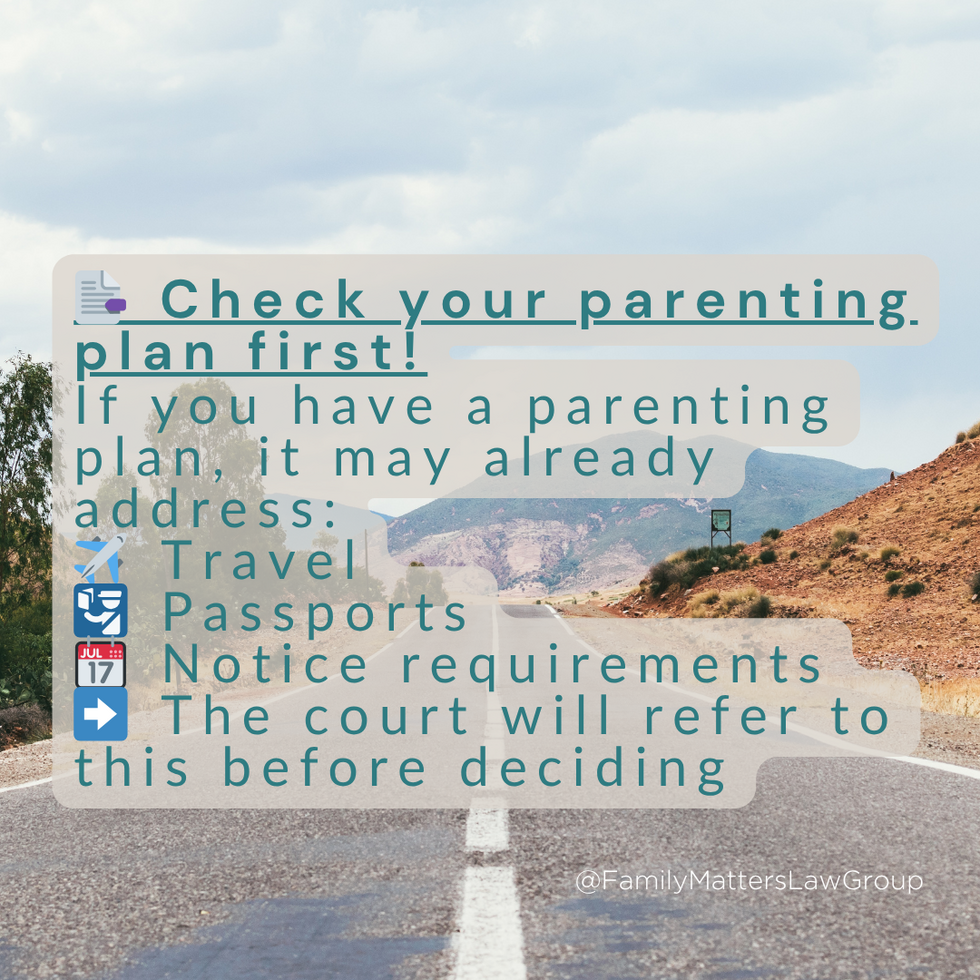
Check Your Parenting Plan First If you already have a parenting plan, check it carefully. Many plans include specific language about:
  • International travel
  • Passport application requirements
  • Notification periods
In many cases, courts won’t issue a new order unless you can show that you’ve followed your current plan — or that the other parent is violating it or creating an unreasonable roadblock.
What Florida Courts Can Do
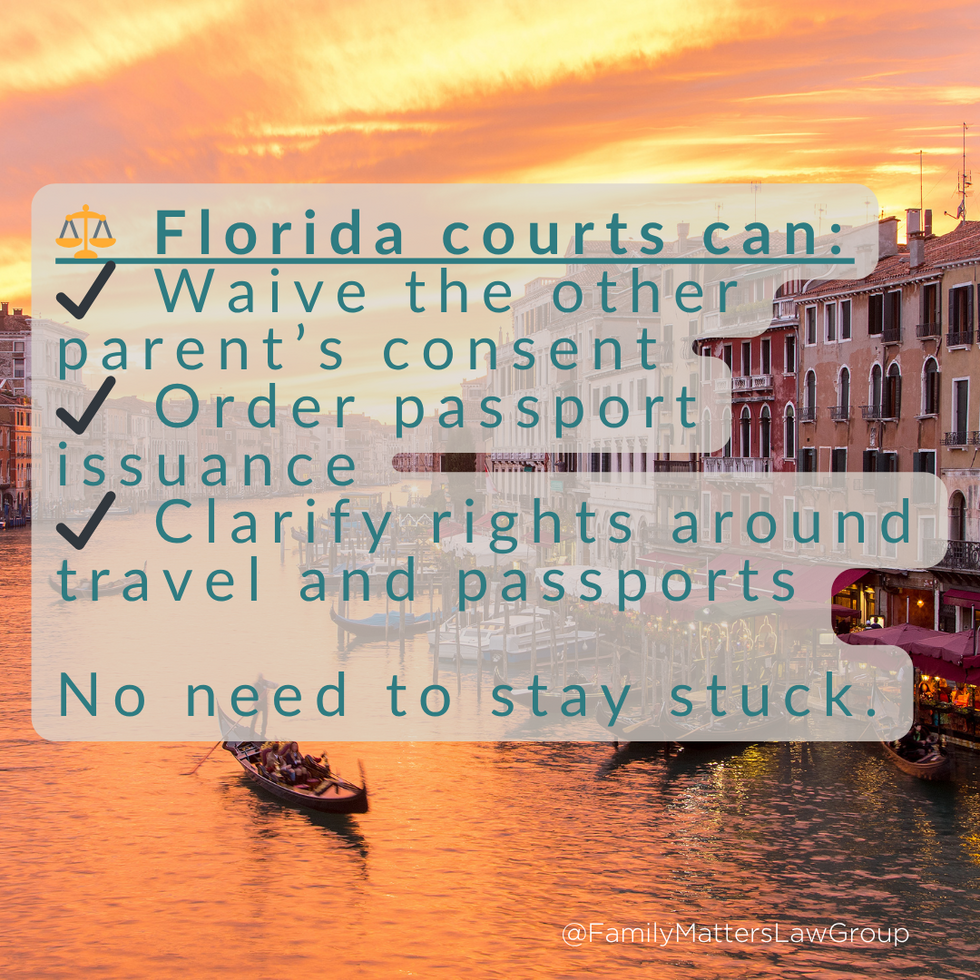
A judge in Florida can:
  • Waive the requirement for the other parent’s signature
  • Authorize you to apply for the passport alone
  • Set clear terms for future travel and passport renewals
But you’ll need to follow the correct filing procedures, submit the right supporting documents, and explain clearly why it’s in your child’s best interest. Need Help Figuring Out What Applies to You? We get it — navigating this stuff alone can feel overwhelming. That’s why we created our DIY Legal Florida Education Group, where you can:
  • Learn the steps to file for passport authorization
  • Get templates and checklists
  • Ask questions and get real guidance (without paying thousands)
And if you need more hands-on support, we also offer strategy sessions and unbundled legal help. Final Thoughts Trying to travel with your child shouldn’t turn into a legal nightmare. If you have sole custody, your path may be simple. If not, you still have options — but you’ll need to go through the right channels. Start by reviewing your parenting plan and custody order. Then decide: ➡️ Can I apply on my own? ➡️ Do I need to file a motion? ➡️ Or do I need help figuring it all out? Either way, we’ve got your back.
📌 Ready to take the next step? Join our free DIY Legal group [insert Mighty Network link], or book a strategy session here. You don’t have to do this alone.

Talk it through before you sign anything

Your intake goes straight to our team — start with a free consult or move straight ahead.

What Happens When Domestic Violence and Family Law Cases Overlap?

Florida Family Law

What Happens When Domestic Violence and Family Law Cases Overlap?

What Happens When Domestic Violence and Family Law Cases Overlap? In Florida, domestic violence and family law cases are handled in separate courts—but when both are pending, they’re often consolidated. Learn how this impacts restraining orders, no-contact agreements, and custody decisions.

This morning, I was in court for a domestic violence return hearing. My client had just hired me over the weekend, and like many cases that come in quickly, I was learning important details in real time. What I discovered once I got to the courthouse is something I want to share — because it highlights a really important legal process that not everyone understands. In Florida, domestic violence cases are handled in a separate court from general family law cases. That means even if you’re already in the middle of a divorce, custody dispute, or parenting plan modification, a restraining order (called an injunction for protection against domestic violence) is handled in a different courtroom, often with a different judge. However, when both a domestic violence injunction and a family law case are pending between the same parties, the two cases are typically consolidated before one judge — most often the family law judge. This is done for consistency and efficiency, especially when the core issues involve parenting and time-sharing. In today’s case, the restraining order hearing had been set in front of the domestic violence judge. But because the other parent had already filed a request to modify their parenting plan, that case was moving forward in family court — and that meant the domestic violence hearing was in the wrong courtroom. It would need to be transferred and reset. But here’s where the courtroom magic happened — and by “magic,” I mean two lawyers being reasonable in the hallway. Instead of forcing the judge to rule on whether a restraining order was necessary, we worked out an agreement: both parties would stay away from one another through a no-contact order within the family law case. This gave everyone the breathing room they needed — no unnecessary litigation, no drawn-out testimony, and no need for emergency relief that wasn’t entirely appropriate. Here’s why this matters:
  • Sometimes, what’s really happening isn’t an act of domestic violence—it’s high-conflict parenting that needs structured boundaries.
  • A restraining order isn’t always the best tool when the real issue is co-parenting and communication.
  • When lawyers work together and stay focused on the actual legal needs, we can move the case forward in a way that serves the family, especially the child.
In the end, we dismissed the domestic violence petition and put a temporary no-contact provision in place through the family law judge, where the real work of sorting out custody, decision-making, and time-sharing will take place. Legal Tip: If you have both a DV case and a family law case pending in Florida, talk to your attorney about whether your hearing is scheduled in the right division. These cases are often better handled together — and can sometimes be resolved without a formal hearing at all. Need help with a high-conflict co-parenting situation or domestic violence case? At Family Matters Law Group, we know how to navigate both sides of the courtroom — and we’re here to help you move forward with clarity and protection. 📩 Start here to get legal representation or advice 🧠 Want to learn how to handle your case yourself? Check out our DIY Legal Coaching & Education options: Explore our free & paid resources

Talk it through before you sign anything

Your intake goes straight to our team — start with a free consult or move straight ahead.

What Does Child Support Actually Cover in Florida—and What Costs Are Split Separately?

Florida Family Law

What Does Child Support Actually Cover in Florida—and What Costs Are Split Separately?

Confused about what child support includes in Florida? Learn which costs are covered and which expenses—like medical, camp, and extracurriculars—should be split between parents. Clear guidance for parenting plans and support orders.

What DoesChild Support Actually Cover in Florida—and What Costs Are Split Separately? In Florida family law cases, one of the most common points of confusion between co-parents is this: What exactly does child support cover—and what doesn’t it cover? Whether you’re preparing a parenting plan, modifying support, or just trying to get clarity, understanding the distinction between what’s included in base child support and what additional costs should be split is crucial. Otherwise, you’re likely to end up with resentment, unnecessary arguments, or unpaid expenses no one budgeted for. Let’s break it down.

What Child Support Is Meant to Cover in Florida

The basic child support amount—calculated using Florida’s child support guidelines—is intended to provide for a child’s essential day-to-day needs. That includes:
  • Housing (rent, mortgage, utilities)
  • Food and groceries
  • Basic clothing and personal care
  • Transportation (gas, car expenses)
  • Basic educational needs (public school access, basic supplies)
This number comes from a formula that considers both parents’ income, the number of overnights each parent has, and some basic expenses like health insurance or child care (if included at the time the calculation was done). But here’s the catch: the guidelines are just a starting point. They don’t cover everything your child might need or do. That’s where “shared” or “split” costs come into play.

What Costs Are Typically Split Separately

Many important and often expensive costs fall outside of the standard support calculation. In Florida, the following are commonly addressed in parenting plans as shared expenses between the parents:
  1. Uncovered Medical Expenses
This includes:
  • Co-pays
  • Prescriptions
  • Therapy (mental health, OT, speech, etc.)
  • Dental and vision care
These are usually split 50/50 unless your agreement says otherwise.
  1. Extracurricular Activities
Think:
  • Sports
  • Music lessons
  • Dance classes
  • Clubs and competitions
Whether your child plays competitive soccer or takes weekly art classes, these costs are usually not part of base child support and should be discussed and addressed in writing.

  1. Camps and Summer Programs
Many families split the cost of:
  • Summer day camps
  • Overnight or specialty camps
  • Spring or winter break programs
These can be major expenses and are often forgotten until summer is around the corner.
  1. Childcare (if not already included)
Childcare is sometimes part of the guideline calculation, but if it wasn’t included when child support was calculated—or if your child starts a new daycare, after-school program, or babysitter—you’ll want to revisit how that cost will be handled.
  1. School-Related Costs
While public school tuition isn’t an issue, these costs are often split:
  • Lab or course fees
  • Class trips
  • Laptop or tablet for school
If your child attends private school, those costs should absolutely be addressed in your parenting plan or by court order.
Why It Matters
If your parenting plan or court order doesn’t clearly state who pays for what, you’re setting yourself up for future conflict. Don’t assume that child support “covers everything.” It doesn’t—and courts know that. At Family Matters Law Group, we help families not just understand these distinctions but build parenting plans that actually reflect real-life parenting. Because being vague about money now almost always leads to fights later. Need help reviewing your child support order or negotiating shared expenses? We offer flat-fee legal coaching, document help, and full legal representation throughout Florida.

Talk it through before you sign anything

Your intake goes straight to our team — start with a free consult or move straight ahead.

When to Use a Private Investigator in a Florida Family Law Case

Florida Family Law

When to Use a Private Investigator in a Florida Family Law Case

Private investigators can play a key role in Florida family law cases involving hidden assets, parenting plan violations, alimony cohabitation claims, and admissible evidence collection. Learn when hiring a PI could be the strategic move your case needs.

When to Use a Private Investigator in a Florida Family Law Case

At Family Matters Law Group, we believe that good strategy requires good information—and sometimes, that information needs to come from a licensed private investigator (PI). In fact, we’ve personally used PIs in three of the four scenarios I’m going to share with you today. So, if you’re wondering whether hiring one is worth it in your divorce, custody, or alimony case—the answer might surprise you. Here are four powerful ways a private investigator can make a difference in your Florida family law case:

1. Uncovering Hidden Assets

Let’s be honest: Some people go to great lengths to hide money when divorce is on the table. They might transfer funds to family members, use crypto accounts, stash cash, or underreport income through their business. While financial affidavits and subpoenas are great tools, they only work if the other party complies—or if you know where to look. A skilled private investigator knows how to find the digital and paper trails of hidden assets. They can uncover undisclosed bank accounts, offshore holdings, luxury purchases, and even evidence of under-the-table income. This can directly impact equitable distribution, child support, and alimony. Florida law requires full financial disclosure. But if someone’s lying? A PI may be your best shot at proving it.

2. Proving Parenting Plan Violations

One of the most emotional aspects of any family law case is child custody and time-sharing. Unfortunately, we’ve seen too many situations where a parent agrees to a schedule or parenting plan—and then breaks it repeatedly. Whether it’s violating the right of first refusal, exposing the child to unsafe individuals, or failing to follow supervised visitation requirements, documentation matters. But your word versus theirs often won’t cut it. A PI can document exchanges, observe conduct, and provide timestamped evidence that holds up in court.

3. Ensuring Evidence Is Admissible

Here’s something most people don’t realize: how you collect evidence is just as important as what the evidence is. That screenshot you took? It may be excluded. The audio recording you made? Possibly illegal. Private investigators follow chain-of-custody protocols, collect data legally, and provide reports that can be admitted as evidence. They understand the rules of evidence in Florida courts. Their neutrality and professionalism make them ideal for situations where emotions run high and proof is everything.

4. Documenting Cohabitation to Modify or End Alimony

If you’re paying permanent or long-term alimony, and your ex has moved in with a new partner, you may have grounds to reduce or terminate your alimony obligation—but you need solid proof. Simply knowing they’re together isn’t enough. Florida courts require evidence that the cohabitation is financially supportive or equivalent to a remarriage. A PI can help establish this by documenting shared expenses, living arrangements, and patterns of behavior that support your petition.

How to Know If You Need a PI in Your Case

You probably don’t need a PI if you and your ex are cooperating, being honest, and playing fair. But if something feels off—if money is vanishing, parenting time is being ignored, or someone’s pretending to live alone when they’re not—don’t rely on guesswork. We’ll never recommend hiring a PI without a reason. But when it’s time? We’ve seen firsthand the difference it can make.
Want to explore more strategies like this?
Join our free DIY Florida Family Law Education Group for blogs, videos, and resources made for people navigating the legal system on their own (or with flat-fee help). Click here to join now. Need more hands-on help? We offer:
  • Flat-fee consultations
  • DIY legal coaching
  • Limited legal representation
    Start here.
And if you’re ready to talk about what’s really happening in your case—we’re ready to listen. Family Matters Law Group, P.A. Florida family law made easier, smarter, and more empowering.

Talk it through before you sign anything

Your intake goes straight to our team — start with a free consult or move straight ahead.