Can the Other Parent Really Ask to Lower Child Support After 8 Years of Doing the Bare Minimum?

Florida Family Law

Can the Other Parent Really Ask to Lower Child Support After 8 Years of Doing the Bare Minimum?

It’s been eight years. The child is older. Both parents are making more money. The non-custodial parent now owns a thriving business—but still hasn’t shown up consistently for their child. They haven’t used their 35 allotted overnights a year, barely visit a few times annually, rarely call or check in, and live three states away. Now, suddenly, they want to go back to court to lower child support? If your head is spinning—you’re not alone. Let’s unpack what’s going on here and what Florida law really says about modifying child support. When Can Child Support Be Modified in Florida? Florida law allows a parent to request a modification of child support, but only when there’s a substantial, permanent, and involuntary change in circumstances. The key words here are:
  • Substantial – The change must be significant (generally at least a 15% difference in the support amount).
  • Permanent – Temporary changes won’t cut it.
  • Involuntary – The change can’t be due to someone choosing to earn less or reduce involvement.
So, if someone has started a thriving business and increased their income, that actually works against a modification—not in favor of one. What About Changes in Timesharing? In some cases, a parent can modify child support if there’s been a shift in how much time each parent spends with the child. But in this scenario, the non-custodial parent hasn’t increased their time at all—in fact, they’ve failed to exercise the time they were already awarded.
  • Not showing up for parenting time?
  • Not engaging in schooling, healthcare, or the child’s day-to-day life?
  • Only seeing the child a few days a year?
That’s not a basis to reduce support. If anything, it highlights why support is needed in the first place. Does the Child’s Reluctance Matter? Absolutely. Courts do consider the emotional well-being of the child. If the child is expressing reluctance to travel out of state, it may be a sign that the out-of-state parent has not built a strong relationship. A parent who has not nurtured a consistent or meaningful connection can’t then use their lack of involvement to argue for less financial responsibility. Child Support Reflects Responsibility, Not Just Time Many people misunderstand child support. It’s not a “payment” for access to your child. It’s a contribution to the financial cost of raising a child—food, housing, clothing, medical care, education, and daily life. It reflects the shared obligation of parenting. If one parent is doing the majority of the physical, emotional, and logistical labor of raising a child, and the other is minimally involved, the courts are unlikely to reward the uninvolved parent by lowering their support obligation—especially when that parent has the means to pay. Final Thoughts If you’re a parent facing a request like this, know that Florida courts will look at the full picture. Increased income, lack of meaningful involvement, and failure to exercise parenting time all weigh heavily against reducing child support. And if you’re the parent to who hasn’t been present, the best path isn’t to pay less—it’s to show up more, consistently and meaningfully. Need help navigating this situation? We’re here for you. At Family Matters Law Group, P.A., we understand the legal and emotional sides of parenting—and we’ll help you protect what matters most.

Talk it through before you sign anything

Your intake goes straight to our team — start with a free consult or move straight ahead.

How Florida Courts Decide Custody: A Breakdown of the 20+ Best Interest Factors

Florida Family Law

How Florida Courts Decide Custody: A Breakdown of the 20+ Best Interest Factors


When parents separate or divorce in Florida, one of the most important—and emotional—issues to resolve is child custody, legally referred to as timesharing. Contrary to what many people believe, the court doesn’t automatically favor mothers or fathers. Instead, Florida courts are guided by a single guiding principle: the best interests of the child. Under Florida Statute §61.13(3), the judge is required to consider over 20 different factors to determine what parenting arrangement supports the child’s emotional, physical, mental, and developmental well-being. Here’s a breakdown of what those factors include and why they matter. 1.  Parental Willingness to Co-Parent The court looks at whether each parent will encourage a close and ongoing relationship with the other parent. Judges want to see that you’re not trying to cut the other parent out—unless there’s a valid safety concern. 2.  Division of Responsibilities Have both parents historically participated in school meetings, doctor appointments, or extracurriculars? If one parent has done it all, that matters.

3.  Stability and Routine Children need predictability. Judges want to know which home will offer consistency in routines, school schedules, and overall daily life. 4.  Geographic Considerations If parents live far apart, the court must consider how travel will impact the child’s school and social life. 5.  Safety and Environment The ability to provide a safe, clean, and nurturing environment is key—whether you’re in a studio apartment or a five-bedroom house.

6.  Moral Fitness This doesn’t mean the court is judging your lifestyle—it’s about how your behavior affects your child. Affairs, substance abuse, or criminal behavior may be relevant if they impact parenting. 7.  Mental and Physical Health Both parents must be mentally and physically capable of handling the demands of raising a child. That said, having a diagnosis doesn’t automatically disqualify you—it’s about function and parenting impact. 8.  Child’s Preference If the child is mature enough (usually older teens), their preference may be considered—but it’s not the only factor. 9.  Home, School, and Community Record The court looks at how well the child is doing in their current environment. A stable school, strong support network, and familiar surroundings can tip the scales. 10.  Parental Involvement Who gets the kids ready for school, helps with homework, attends games or recitals? Judges often favor the parent who’s been more actively involved. 11.  Discipline and Parenting Style Consistent and appropriate discipline matters. Harsh or inconsistent approaches can raise red flags.

12.  Flexibility and Cooperation Parents who can work together, be flexible, and put their child’s needs above petty disputes often earn credibility with the court. 13.  Communication Skills Being able to respectfully communicate about your child is critical—especially if shared parental responsibility is ordered. 14.  Substance Abuse Issues Drug or alcohol problems—past or present—will absolutely be considered, particularly if they impact judgment or parenting ability. 15.  Domestic Violence Even without a conviction, allegations or documented concerns about domestic violence will weigh heavily in the court’s decision. 16.  Involvement in the Child’s Life Attending school meetings, doctor appointments, and extracurricular events signals commitment and involvement. 17.  Support Network Do you have family nearby? Friends who help out? A strong support system can help provide stability for the child. 18.  Protecting the Child from Conflict The court wants to see that you’re shielding your child from legal battles and adult arguments—not pulling them into it.
19.  Information Sharing Are you giving the other parent access to school reports, medical info, and other key updates? Or are you gatekeeping? 20.  Following Court Orders If you’ve already shown a disregard for past court orders, that could influence how much discretion you’re given moving forward. 21.  Catch-All Provision Finally, the court can consider any other factor that affects the child’s welfare and well-being. Bottom Line: When it comes to timesharing, Florida courts don’t make decisions based on gender, income, or who “seems like the better parent.” They evaluate every detail of your child’s life and your parenting behaviors—past and present. At Family Matters Law Group, P.A., we work with our clients to build strong, child-focused parenting plans and present compelling, fact-based cases to the court. If you’re preparing for a custody or timesharing case, we’re here to guide you every step of the way. Contact us today to schedule a consultation.

Talk it through before you sign anything

Your intake goes straight to our team — start with a free consult or move straight ahead.

“Is My Spouse Entitled to Money in a Bank Account That’s Only in My Name?”

Florida Family Law

“Is My Spouse Entitled to Money in a Bank Account That’s Only in My Name?”

When couples begin the divorce process, one of the first and most emotional issues to sort through is money. One question we hear all the time is: “If my spouse’s name isn’t on my bank account, is that money still considered marital?” The short answer? Maybe — and in many cases, yes. Let’s break it down: Florida Is an Equitable Distribution State In Florida, the law says that anything acquired during the marriage — assets or debts — is presumed to be marital property, unless you can prove otherwise. That includes:
  • Bank accounts
  • Real estate
  • Retirement accounts
  • Vehicles
  • Businesses
  • And yes… even money in a savings account that your spouse’s name is not on.
So, even if you and your mom opened the account years ago, and your spouse has never touched it, the key question is this: Did any money get deposited into that account during the marriage? If the answer is yes — and that money came from income you earned during the marriage — then that portion of the account may be considered marital and subject to division. Understanding “Commingling” You might be thinking: “But the account is mine! It was opened in college with my mom. He was never part of it!” That’s a fair point — but if money earned during the marriage was placed into the account, even an old account can become “commingled.” Commingling happens when marital money and non-marital money get mixed together in a way that makes it hard to separate them. For example:
  • You had $10,000 saved before marriage.
  • During the marriage, you deposited your paychecks into the same account.
  • You used the account for joint expenses or to pay marital bills.
Now it’s hard to trace which money was yours and which was “ours.” The court may treat the account — or a portion of it — as marital.

What If My Mom Is Also on the Account? Adding a third party to an account, like a parent, can complicate things. But it doesn’t automatically shield the money from division. If the account primarily holds your earnings or was used for marital expenses, your spouse could still have a claim to some of it — even if your parent is also on the account. What Counts as Non-Marital Property? Not everything acquired during a marriage is subject to division. The following are typically considered non-marital, if kept separate:
  • Assets you owned before the marriage (and didn’t commingle)
  • Inheritances given to you alone
  • Gifts given specifically to you (not both spouses)
  • Money explicitly protected by a prenuptial or postnuptial agreement
Even then, it’s important to show clear records that you kept those funds separate throughout the marriage. How Can I Protect Myself? If you’re heading toward divorce and you’re concerned about money in your personal account, here are some tips:
  • Get clear records: Gather statements that show when the account was opened and where the deposits came from.
  • Don’t move money around: Transfers or withdrawals during divorce can raise red flags or lead to accusations of hiding assets.
  • Talk to a lawyer early: An experienced family law attorney can help you understand what’s truly yours — and what isn’t.
Bottom Line Just because your spouse’s name isn’t on a bank account doesn’t mean they have no claim to the money. In Florida divorce cases, what matters most is when and how the money was acquired and used. Every situation is different. If you’re unsure whether an account is safe from division — or if you want to know how to protect your financial future — let’s talk. At Family Matters Law Group, P.A., we help you navigate divorce with clarity, strategy, and strength. Schedule a consultation or check out our DIY legal services if you’re not ready for full representation. Need help figuring out what’s marital and what’s not? We’re here for you. #DivorceInFlorida #BankAccountsInDivorce #EquitableDistribution #FloridaFamilyLaw #FamilyMattersLawGroup #MoneyAndMarriage #ProtectYourAssets #DivorceHelp #LegalAdvice #DIYDivorceSupport

Talk it through before you sign anything

Your intake goes straight to our team — start with a free consult or move straight ahead.

Why You Shouldn’t Ignore Temporary Agreements During Divorce

Florida Family Law

Why You Shouldn’t Ignore Temporary Agreements During Divorce


When you’re in the middle of a divorce, it’s easy to feel like you’re just trying to survive the day-to-day chaos. In the early stages, you might agree to “temporary” solutions for timesharing, support, or living arrangements, just to keep the peace or move things forward. But here’s the reality: temporary agreements often have long-term consequences. At Family Matters Law Group, P.A., we make sure our clients understand that every decision made during a divorce matters — including the temporary ones. Here’s why you should treat those early agreements with the same seriousness as the final settlement. Temporary Agreements Set the Tone for Your Entire Case The court is watching. Even though these arrangements are technically temporary, judges often look at how well temporary agreements are working when making final rulings. If you’ve been following a certain parenting plan or support arrangement for months, it can become the new “status quo” in the eyes of the court. For example:
  • If you agree to limited timesharing now, it may be harder later to argue for equal timesharing.
  • If you accept a low amount of temporary support, the final support amount could be based on that figure.
  • If you agree to move out of the marital home without protections in place, you might weaken your claim to the property.
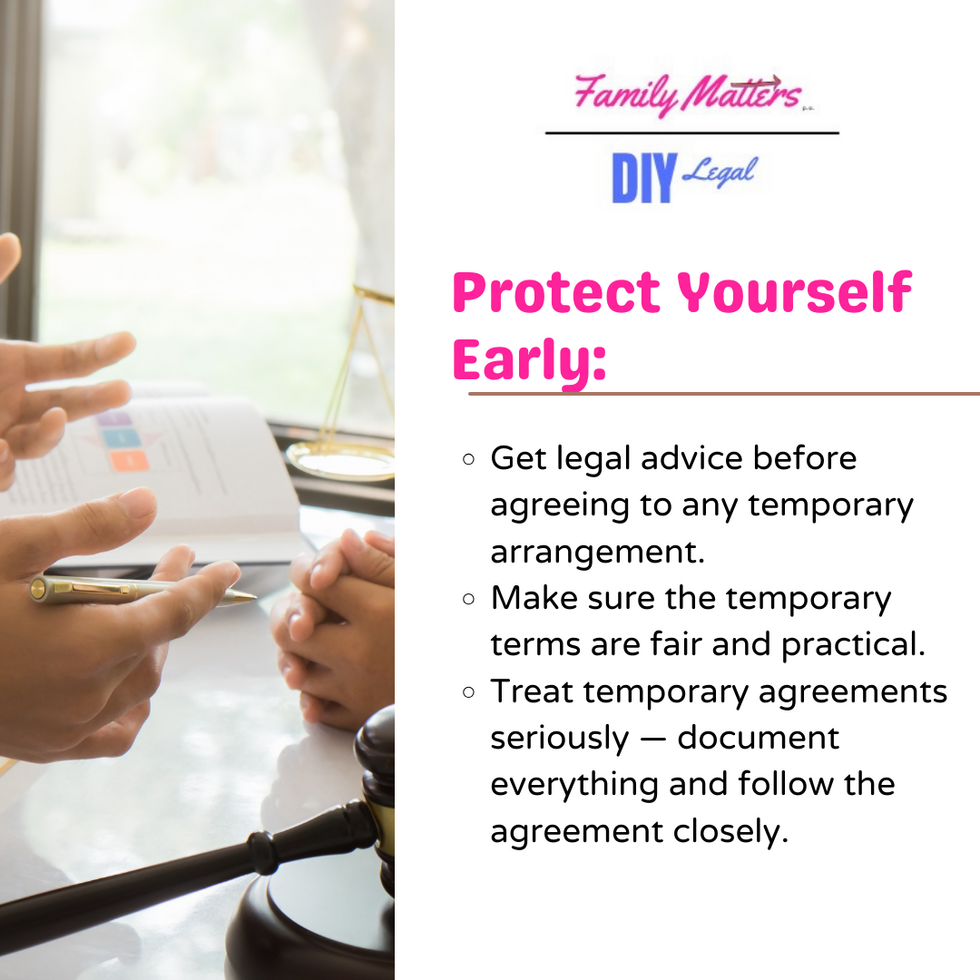
The lesson: Don’t agree to something just to “get through it.” Make sure the terms are fair, reasonable, and sustainable. Early Mistakes Are Hard to Undo One of the biggest mistakes we see is clients agreeing to something temporary without fully thinking it through — and then regretting it when it becomes difficult to change. Courts prioritize stability for children and financial consistency for families. If something has been working, even imperfectly, courts are often reluctant to disrupt it. Changing an arrangement later requires showing that circumstances have changed significantly, or that the original agreement is clearly not in the child’s best interests — a much higher burden than simply negotiating strong terms upfront. Protect Yourself from the Start Here are a few tips for protecting yourself when negotiating temporary agreements:
  • Consult an attorney before agreeing to anything. Even if you feel pressured to “keep things civil,” you still need legal advice.
  • Document everything. Any agreements should be in writing, and ideally filed with the court if appropriate.
  • Think long-term. Don’t agree to something you wouldn’t want to live with for a year or more.
  • Ask questions. Make sure you fully understand the consequences of any arrangement you are considering.
At Family Matters Law Group, P.A., we help our clients think strategically from the very beginning. We don’t just react to what’s happening now — we help you plan for where you want to be when the case is over. Conclusion: Start Strong, Stay Strong In family law, the temporary often becomes permanent. That’s why it’s critical to treat temporary agreements with the seriousness they deserve. Protecting your rights early can make a major difference in the final outcome of your case. If you’re facing a divorce or custody case, don’t navigate these crucial early decisions alone. Contact Family Matters Law Group, P.A. today to schedule a consultation and get the strategic guidance you need from day one. SEO Notes (you can add to the meta/description if needed):
  • Meta description: “

Talk it through before you sign anything

Your intake goes straight to our team — start with a free consult or move straight ahead.

Is Child Support Unconstitutional? Let’s Break Down the Facts.

Florida Family Law

Is Child Support Unconstitutional? Let’s Break Down the Facts.


At Family Matters Law Group, P.A., we frequently hear concerns about how child support works, especially in the age of social media where misinformation spreads fast. One question that’s come up recently is whether child support enforcement violates due process rights—and whether courts are “incentivized” to place people on child support to make money for the government. This concern often references 42 U.S. Code § 658, a federal law related to incentive payments to states for child support enforcement. Let’s clear up what this law actually means, and why it does not violate constitutional rights. What Is 42 U.S. Code § 658? This federal statute allows states to receive incentive payments from the federal government when they effectively enforce child support orders. These incentives are based on performance measures—such as how many support orders are established and how much is collected—not whether a judge decides to issue a child support order in the first place. So why would the federal government want to incentivize states to enforce child support? Because it helps reduce the burden on public assistance programs like:
  • Temporary Assistance for Needy Families (TANF)
  • Medicaid
  • SNAP (formerly known as food stamps)
When child support is paid consistently, children have their needs met, and fewer families require government aid. This benefits not just the child and custodial parent, but also taxpayers and the broader economy. It’s a financial and social investment in child welfare—not a secret scheme to profit off struggling parents. Does This Violate Due Process? No. Courts are still bound by constitutional protections. If someone is going to be ordered to pay child support, due process requires that:
  • They are served with proper notice of the case.
  • They are given the opportunity to respond and appear in court.
  • They can present evidence and dispute any inaccurate claims about their income or ability to pay.
Due process violations can and do happen in rare cases—like when someone wasn’t properly served or never had a hearing—but that’s a procedural error, not an inherent flaw in the system. These issues are typically grounds for appeal or modification, not a reason to invalidate the entire concept of child support. Why Child Support Exists At its core, child support exists to ensure that both parents contribute to the financial needs of their children. It’s based on statutory guidelines that consider income, number of overnights, childcare costs, health insurance, and other factors. Contrary to the online rhetoric, child support is not punitive—it’s protective. Family courts aren’t looking to punish one parent or profit from enforcement. They’re trying to make sure children don’t go without basic necessities just because their parents no longer live together. Common Myths—Debunked MYTH: The courts make money by putting people on child support. FACT: Courts don’t receive direct revenue from child support orders. Incentive funds go to the state child support enforcement agencies to improve enforcement systems—not to judges or court staff. MYTH: You don’t have any say in what you’re ordered to pay. FACT: You absolutely do. You can file financial affidavits, present pay stubs and tax returns, and request hearings to argue for accurate calculations. MYTH: The whole system is unconstitutional. FACT: Courts must follow due process, and child support enforcement is grounded in state and federal law aimed at protecting children, not violating your rights. The Bottom Line We understand that the family court system can feel overwhelming, especially if you’re navigating it alone. But we also believe in cutting through the noise and giving people the real information they need to understand their rights and responsibilities. If you’re facing a child support issue—or if you’ve been served and aren’t sure what to do next—we’re here to help. Whether you need representation, legal coaching, or just clarity on your options, Family Matters Law Group, P.A. has you covered. Contact us today to schedule a consultation and get the guidance you deserve. Family Matters Law Group, P.A. Protecting Families. Empowering Clients. Tags: child support enforcement Florida, 42 USC 658 explained, is child support unconstitutional, due process child support hearing, Florida family law attorney, family court myths, child support rights, how child support works, legal help with child support, South Florida custody lawyer

Talk it through before you sign anything

Your intake goes straight to our team — start with a free consult or move straight ahead.

Navigating Parental Rights and Property Disputes in Unmarried Relationships in Florida

Florida Family Law

Navigating Parental Rights and Property Disputes in Unmarried Relationships in Florida

Navigating Parental Rights and Property Disputes in Unmarried Relationships in Florida When an unmarried couple with children separates, they often face complicated legal and emotional challenges. Unlike married couples, who can resolve custody and property division through a divorce, unmarried parents must take separate legal steps to establish parental rights and divide jointly owned property. This blog will cover what an unmarried father can do to secure his parenting rights, how property disputes are handled, and how family attorneys can help find a resolution. Parental Rights for Unmarried Fathers in Florida In Florida, if a father is listed on the birth certificate, there is a legal presumption of paternity. However, this does not automatically grant the father parental rights, such as custody (timesharing) or decision-making authority. To ensure those rights are protected, an unmarried father must file a Petition to Establish Paternity. This legal process serves several purposes:
  1. Establishes a Legal Parenting Plan – Without a court-ordered parenting plan, the mother has sole legal rights to the child, including the ability to dictate timesharing and decision-making. A formal plan outlines each parent’s rights, responsibilities, and a legally enforceable custody schedule.

  2. Ensures Fair Timesharing – If a father is being denied time with his child, a court order will ensure that both parents have defined and enforceable time with their child.

  3. Determines Child Support Obligations – Child support is part of the paternity process and is calculated based on each parent’s income, expenses, and the time each parent spends with the child. Even if both parents verbally agree on financial contributions, only a court order can enforce fair and legal child support obligations.

Without filing for paternity, a father risks limited access to his child and no legal say in parenting decisions. While some parents can work out agreements informally, those arrangements are not legally binding and can be revoked at any time by either parent. Property Disputes for Unmarried Couples When a couple is not married, property disputes—such as ownership of a shared home—are not handled in family court. Instead, they must be resolved through Florida’s civil court system, typically by filing a partition action if both parties are on the deed. A partition action forces the sale or division of the property, ensuring that each party receives their fair share. However, in many cases, experienced family law attorneys can negotiate a property settlement as part of the paternity case, even though the house itself is not technically included in the family court process. This can be a faster and more cost-effective solution than going through a separate civil court case. Dealing with Co-Parenting Challenges and Family Boundaries Beyond the legal aspects, navigating a co-parenting relationship—especially when emotions are high—can be challenging. In this case, the mother of the child is not only limiting the father’s access but also attempting to impose control over the grandparents’ home. While maintaining a safe environment for the child is important, co-parents should not use personal opinions or control tactics to restrict access unreasonably. If a parent believes their co-parent is being unnecessarily controlling or overstepping boundaries, it’s another reason why a formal parenting plan is crucial. A court order prevents one parent from making unilateral decisions about the other parent’s time with the child. How to Move Forward If you or a loved one is facing a similar situation, here’s what needs to happen:

  1. File a Petition to Establish Paternity – This is the first step in securing legal rights as a father and establishing a parenting plan.
  2. Negotiate a Property Settlement – If the home is jointly owned, work with attorneys to reach a fair agreement without needing a separate partition lawsuit.
  3. Set Boundaries in Co-Parenting – Having a legally binding agreement protects parental rights and helps prevent one parent from overstepping.
  4. Seek Legal Guidance – A skilled family law attorney can help navigate the legal process and advocate for a fair resolution.
At Family Matters Law Group, P.A., we specialize in helping unmarried parents navigate their rights, establish fair parenting plans, and resolve property disputes effectively. If you’re in a similar situation, reach out to us for guidance on your next steps.

Talk it through before you sign anything

Your intake goes straight to our team — start with a free consult or move straight ahead.

Hair Follicle Drug Testing in Florida Custody Cases: What You Need to Know

Florida Family Law

Hair Follicle Drug Testing in Florida Custody Cases: What You Need to Know

Hair Follicle Drug Testing in Florida Custody Cases: What You Need to Know

When custody cases involve allegations of drug use, Florida family courts often order drug testing to determine whether a parent’s substance use may impact their ability to care for a child. One of the most commonly requested drug tests is the hair follicle test because of its long detection window and difficulty to evade. If you have been asked to take a hair follicle drug test in a custody case, here’s what you need to know. What is a Hair Follicle Drug Test? A hair follicle drug test analyzes a small sample of hair to detect drug use. Unlike urine tests, which typically detect substances for a few days to a few weeks, hair follicle tests can detect drug use up to 90 days prior to the test date. This extended detection period makes them a preferred option in custody cases where long-term patterns of drug use are a concern. Substances Hair Follicle Tests Commonly Detect: Most standard hair follicle tests check for the following substances: • Amphetamines, Methamphetamines, and Ecstasy (MDMA) • Marijuana (THC) • Cocaine • Opiates (Codeine, Morphine, Heroin Metabolite – 6-Acetylmorphine) • Phencyclidine (PCP) Some expanded panels may also test for prescription medications such as benzodiazepines (Xanax, Valium), barbiturates, synthetic opioids (Oxycodone, Hydrocodone), and others. If a party believes a parent may be abusing prescription medications, they may request a more comprehensive screening. Why Are Hair Follicle Tests Used in Custody Cases? Florida courts prioritize the best interests of the child in custody and timesharing cases. If one parent raises concerns about the other’s substance use, a judge may order a drug test to determine if it poses a risk to the child’s safety or well-being. Since hair follicle testing provides a long-term view of drug use, it is particularly useful in cases where one party alleges ongoing or habitual drug use rather than a one-time incident. How Hair Follicle Tests Are Collected • The sample must come directly from your person, meaning you cannot submit someone else’s hair. • The hair is usually collected from the scalp, but if there is not enough hair, the sample can be taken from the arms, legs, armpits, or pubic area. • Dyeing, bleaching, or shaving your head will not prevent the test. If you attempt to remove all body hair, the court may assume you are avoiding the test and could rule against you. How Hair Follicle Drug Tests Can Impact Custody Cases A positive drug test in a custody case can significantly impact timesharing and parental responsibility. However, the severity of the impact depends on:
  1. Which drug(s) were detected – For example, a positive cocaine test may be viewed more harshly than a positive marijuana test, particularly as marijuana laws continue to evolve.

  2. The levels of detection – Some tests can indicate frequency of use or whether use exceeds prescribed amounts for certain medications.

  3. The judge’s discretion – Florida judges have wide discretion in custody cases. Some may be more lenient if a parent acknowledges the issue and agrees to testing and treatment, while others may impose supervised visitation or limit parental contact until the issue is resolved.

Potential Consequences of a Positive Test • Temporary Restrictions on Timesharing: If a parent tests positive, the judge may suspend or reduce their timesharing until they provide clean follow-up tests. • Supervised Visitation: The court may order supervised visitation to ensure the child’s safety. • Mandatory Follow-Up Testing: A parent with a positive test may need to submit to random drug testing to prove they are no longer using substances. • Substance Abuse Evaluations and Treatment: In some cases, the judge may require drug counseling, rehab, or parenting classes before reinstating full parental rights. • Dependency Proceedings: If drug use is severe or ongoing, the Department of Children and Families (DCF) may get involved, leading to a possible dependency case where parental rights could be at risk. What Are Your Options If You Are Asked to Take a Hair Follicle Drug Test? If you are asked to take a hair follicle drug test in your Florida custody case, you have two options: 1. Agree to Take the Test • The cost of the test typically starts at $300 and can increase depending on the testing facility and the number of substances screened. • If you test negative, you may request that the other parent reimburse you for the cost. • If you test positive, it is important to consult with an attorney immediately to discuss damage control and next steps. 2. Refuse to Take the Test and Require a Motion to Compel • If you refuse to take the test voluntarily, the other party must file a Motion to Compel with the court. • A hearing will be scheduled, where the judge will decide whether testing is necessary. • The requesting party must provide evidence suggesting recent drug use, such as: • Testimony from witnesses • Photos or videos showing drug use or paraphernalia • Text messages, emails, or social media posts referencing drug use • If the judge grants the Motion to Compel, you will likely be required to take the test immediately. Warning: Refusing a drug test without a valid reason may make you look uncooperative or suggest to the judge that you have something to hide. Judges can infer negative conclusions from a refusal. What If You Get a Positive Test Result? If you test positive, the most important thing to do is take immediate steps to address the issue. This may include: • Requesting a retest (if you believe the result was a false positive) • Providing proof of legal prescription use (if applicable) • Voluntarily attending drug counseling or treatment • Complying with any additional court-ordered testing • Demonstrating sobriety through follow-up negative tests A follow-up clean test within 60-90 days can sometimes help mitigate damage in custody proceedings. However, in more serious cases, a parent may need to undergo counseling, parenting classes, or other rehabilitative steps before regaining full timesharing rights. Final Thoughts: Protecting Your Rights in a Custody Case If you are facing a drug test in a Florida custody case, it is critical to consult with a family law attorney immediately. Your parental rights and timesharing could be at stake, and having a legal strategy in place is essential to protecting your relationship with your child. At Family Matters Law Group, P.A., we have extensive experience handling custody cases involving drug testing, timesharing disputes, and parental rights issues. If you need legal guidance, contact us today to schedule a consultation. Tags: Florida custody, drug testing, timesharing, parental responsibility, substance abuse in custody cases

Talk it through before you sign anything

Your intake goes straight to our team — start with a free consult or move straight ahead.

Understanding the Tax Impact of IRA and 401(k) Division in Divorce

Florida Family Law

Understanding the Tax Impact of IRA and 401(k) Division in Divorce

Understanding the Tax Impact of IRA and 401(k) Division in Divorce Dividing retirement accounts such as IRAs and 401(k)s in a divorce can be complicated, especially when it comes to tax implications. One common issue that arises is whether these assets should be “tax-effected” when equitably dividing them between spouses. Some attorneys argue that their client should receive more in the division due to future tax liabilities upon withdrawal, but is this always justified? When Should Retirement Accounts Be Tax-Effected? The general rule in Florida family law is that when dividing retirement accounts equally between spouses, tax implications are not typically factored in because both parties will eventually pay taxes when they withdraw the funds. However, there are exceptions. 1. If the Retirement Account is Being Exchanged for a Non-Taxable Asset If one spouse is keeping a retirement account while the other is receiving a different asset, such as a home, bank account, or investment that is not subject to future taxes, it is reasonable to adjust the division based on the “net” value of the retirement account after anticipated taxes. Example: • Spouse A keeps a 401(k) worth $100,000. • Spouse B keeps a house worth $100,000 (fully paid off). At first glance, this seems like an equal split, but the 401(k) will be taxed when withdrawn, while the home is a non-taxable asset. If Spouse A has to pay approximately 22% in taxes upon withdrawal, their actual “net” value would be around $78,000. In this case, it may be reasonable for Spouse A to receive additional assets to make the division fair. 2. If the Retirement Account is Simply Being Split Between Spouses If both spouses are receiving a portion of the retirement account, then no tax effect should be applied because both will face the same tax liability when they withdraw their shares. Example: • A 401(k) worth $200,000 is divided 50/50 between Spouse A and Spouse B. • Each receives $100,000. Since both parties will pay taxes on their respective portions, it would not be appropriate to claim one spouse should receive more in the divorce settlement due to future tax burdens. Using a QDRO to Divide a 401(k) Without Penalties A Qualified Domestic Relations Order (QDRO) is the legal document used to divide a 401(k) or pension plan in a divorce. Here’s what spouses need to know: • The non-participant spouse (alternate payee) can roll over their share into an IRA to avoid immediate taxes. • If the alternate payee withdraws the funds immediately, they will owe income taxes, but they won’t have to pay the 10% early withdrawal penalty (if done through the QDRO). • If the alternate payee rolls over the funds into an IRA and then later withdraws, they will be subject to the 10% penalty if they withdraw before age 59½. Example: • Spouse A has a 401(k) worth $300,000. • A QDRO awards Spouse B $150,000. • If Spouse B withdraws the $150,000 immediately, they will owe taxes but no penalty. • If Spouse B rolls it into an IRA and withdraws later before 59½, they will owe taxes and a 10% penalty. Key Takeaways

  1. If a retirement account is being exchanged for a non-taxable asset, it may be reasonable to adjust for taxes.

  2. If both spouses are splitting the retirement account, it should not be tax-effected since both will face the same tax consequences.

  3. Using a QDRO correctly can help avoid penalties if a spouse needs access to the funds before retirement.

  4. Working with an experienced attorney can ensure retirement accounts are divided correctly and fairly.

If you need help with aspects of your divorce, Family Matters Law Group, P.A. is here to assist you. We specialize in handling complex asset division and ensuring that you get a fair outcome. Contact us today to discuss your case!

Talk it through before you sign anything

Your intake goes straight to our team — start with a free consult or move straight ahead.

The Mediation Dilemma: When Too Many Opinions Derail a Divorce Settlement

Florida Family Law

The Mediation Dilemma: When Too Many Opinions Derail a Divorce Settlement

Mediation is one of the most effective ways to resolve divorce and child custody disputes without the stress and cost of a long court battle. It allows both parties to negotiate a settlement on their own terms, rather than leaving major life decisions—like child support, parenting plans, alimony, and asset division—up to a judge. However, one of the biggest challenges in mediation comes after you leave the negotiation table but before signing the agreement. This is when people often make a costly mistake: seeking legal advice from the wrong people. John talks to his best friend, who went through a Florida divorce five years ago, and Sally vents to her cousin, who had a difficult custody battle. Both hear conflicting advice that shakes their confidence in the deal. Suddenly, they’re questioning everything: • Did I give up too much in the parenting plan? • Should I have pushed for more alimony? • Is this a fair child support arrangement? • Did I just agree to a raw deal? And just like that, a carefully negotiated divorce settlement starts to unravel. Why Listening to Outside Opinions Can Hurt Your Divorce Case Seeking emotional support from family and friends is natural, but taking legal advice from them is risky. Here’s why: 1️⃣ Every Divorce Case is Unique Divorce and custody cases depend on a variety of factors, including: • Income and earning potential of both spouses • Assets and debts accumulated during the marriage • Timesharing (child custody) schedules and co-parenting dynamics • The specific judge assigned to the case What worked in one case may not apply at all to another. Comparing divorce settlements without considering these unique elements leads to unrealistic expectations. 2️⃣ Non-Lawyers Don’t Understand Family Law Friends and family often have strong opinions, but they lack the legal expertise to evaluate whether a mediation agreement is actually fair under Florida law. For example, someone might say, “I got full custody—so should you!” without realizing that Florida courts prioritize shared parental responsibility unless there’s a serious reason, such as abuse or neglect. Similarly, someone might claim, “I got way more alimony,” but Florida alimony laws have changed, and long-term alimony is now harder to obtain. 3️⃣ Bad Advice Leads to Delays & Missed Opportunities When people second-guess their mediation agreement based on outside opinions, they often delay signing—or worse, walk away from a fair deal entirely. This can backfire because: ✅ Going to court is unpredictable. A judge may issue a ruling that’s far less favorable than the agreement you originally had. ✅ Litigation is expensive. The longer a case drags out, the more legal fees both parties incur. ✅ Delays create stress. Finalizing your divorce sooner allows you to move forward with your life. Protecting Your Mediation Agreement from Outside Influence To avoid falling into the “too many opinions” trap, follow these key strategies: 🔹 Trust your Florida divorce attorney. If you’ve hired an experienced family law attorney, rely on their legal expertise instead of non-lawyer advice. They know the law, the judges, and what is realistic in your case. 🔹 Understand that mediation is about compromise. No one gets everything they want in a divorce. The goal is to reach a fair resolution that works for your life. 🔹 Limit discussions about your case. Seek emotional support from friends and family, but don’t let them dictate your legal decisions. If you have doubts, consult your attorney—not your neighbor, co-worker, or cousin who got divorced in another state. Final Thoughts: A Signed Agreement is the Goal Until a mediation agreement is signed, it is not enforceable. People change their minds, outside opinions create doubt, and delays can cause even a great deal to fall apart. If you leave mediation with a fair settlement, don’t let outside noise make you second-guess it. Your future isn’t determined by someone else’s divorce—it’s shaped by the choices you make today. Need Help with Divorce Mediation in Florida? At Family Matters Law Group, P.A., we help clients navigate the complexities of divorce, child custody, parenting plans, child support, and alimony. Our experienced Florida family law attorneys can guide you through mediation and ensure you make informed decisions that protect your future. 📞 Schedule a Consultation Today! #FloridaDivorce #DivorceMediation #ChildCustody #CoParenting #ParentingPlan #ChildSupport #FloridaFamilyLaw #Alimony #Timesharing #CustodyAgreement #DivorceAttorney #FamilyLaw #MediationMatters #KnowYourRights

Talk it through before you sign anything

Your intake goes straight to our team — start with a free consult or move straight ahead.

Who Pays for a Guardian ad Litem in Family Law Cases?

Florida Family Law

Who Pays for a Guardian ad Litem in Family Law Cases?

Who Pays for a Guardian ad Litem in Family Law Cases? One of the most common questions we get asked is, “Who pays for the Guardian ad Litem (GAL) in a family law case?” Many people assume that GALs are paid by the state, similar to court-appointed attorneys in criminal cases. However, in private family law matters, that is not the case. When a Guardian ad Litem is appointed in a divorce, paternity, or other custody-related dispute, the fees are typically the responsibility of the parents. How Are Guardian ad Litem Fees Paid? When a GAL is appointed in a case, the court usually determines how their fees will be divided. There are several common ways this can happen: 1. One Parent Pays 100% • In some cases, one parent may be ordered to pay the full cost of the GAL. This can happen for a variety of reasons, including if one parent has significantly more financial resources or if the court finds that one party’s actions made the GAL’s involvement necessary. 2. Parents Split the Fees Equally • Often, courts will order that both parents share the cost of the Guardian ad Litem equally. This is common when both parties have similar financial means, and the GAL is seen as a neutral advocate for the child’s best interests. 3. Fees Are Paid Pro Rata Based on Income • When there is a large difference in income between the parents, the court may order a pro rata payment structure. This means that each parent pays a portion of the GAL’s fees based on their respective percentage of the total combined income. For example, if one parent earns 70% of the total household income and the other earns 30%, the fees may be divided accordingly. Costs Associated with a Guardian ad Litem The cost of a Guardian ad Litem can vary depending on several factors, including: • The complexity of the case • The number of children involved • The amount of time the GAL spends investigating • Whether travel is required for interviews or court appearances For example, in cases where extensive work is needed—such as reviewing documents, conducting multiple interviews, attending court hearings, and preparing reports—the fees can add up. However, the involvement of a Guardian ad Litem can be invaluable in ensuring that a child’s best interests are properly represented in court. Can One Parent Be Ordered to Pay the Other’s Share of the GAL Fees? Yes, in some cases, the court may order one parent to cover the other parent’s share of the GAL fees. This often happens when there is a significant financial disparity between the parents, or if one party has engaged in misconduct that led to the GAL’s appointment. Additionally, if a parent refuses to pay their court-ordered share of the fees, the other parent can ask the court to enforce the payment. Why a Guardian ad Litem Can Be Worth the Cost While hiring a Guardian ad Litem does involve additional costs, their role is critical in highly contested family law cases. A GAL provides the court with an objective perspective on what is best for the child, based on thorough investigations, interviews, and observations. In many cases, having a GAL involved can help expedite a resolution by providing clear recommendations to the court, potentially saving time and legal fees in the long run. Final Thoughts A Guardian ad Litem in private family law cases is not funded by the state. Instead, the parents are responsible for covering the fees, whether that means one parent pays in full, both share the costs equally, or they pay based on income percentages. If you are involved in a case where a GAL has been appointed, understanding the financial responsibilities can help you plan accordingly. If you have questions about Guardian ad Litem fees or how they apply to your case, Family Matters Law Group, P.A. is here to help. Contact us today to learn more about your options.

Talk it through before you sign anything

Your intake goes straight to our team — start with a free consult or move straight ahead.