You Can’t Ignore a Court-Appointed Guardian ad Litem (Even If You Don’t Like Them)

Florida Family Law

You Can’t Ignore a Court-Appointed Guardian ad Litem (Even If You Don’t Like Them)

If a Guardian ad Litem is appointed in your Florida family law case, you cannot ignore or “fire” them. Learn what their role is and why refusing to cooperate can seriously hurt your case.

A follower recently commented on one of my videos after a Guardian ad Litem was appointed in their case. The tone was clear: they didn’t like it, they didn’t agree with it, and they wanted to know if they could simply refuse to deal with the guardian. Let’s clear this up. Once a Guardian ad Litem is appointed, that appointment is a court order. Not a suggestion. Not optional. Not something you can override because you’re upset.

What Is a Guardian ad Litem?

In Florida family law cases, a Guardian ad Litem (GAL) is appointed by the judge to investigate and make recommendations about what is in the best interest of the child. The GAL becomes a party to the case. Their role is to gather information, speak to the parents, possibly speak to the child, review documents, talk to teachers, therapists, and other relevant witnesses, and then provide recommendations to the court. The GAL is not there to “take sides.” The GAL is there to assess facts and present what they believe serves the child’s best interests. And here is the key point: once appointed, the GAL’s authority comes from the judge.

You Cannot “Fire” a Court-Appointed Guardian

I have personally received emails that say, “You’re fired.” No. That’s not how this works. The only person who can discharge a Guardian ad Litem is the judge. Even if both parents agree they no longer want a guardian involved, the appointment remains in effect until the court enters an order discharging that guardian. When I am appointed and accept the role, I have a legal obligation to fulfill the duties of that position until the judge says otherwise. Parents do not have the authority to undo a court order by email. Refusing to Communicate Is a Strategic Mistake

Let’s talk about the practical side.

You may not like the guardian. You may feel misunderstood. You may believe the appointment was unnecessary or unfair. But if you refuse to communicate, refuse to provide information, or refuse to participate in the process, you are hurting yourself. Every case has multiple perspectives. Two sides, sometimes three, sometimes more. The Guardian ad Litem is tasked with sorting through those perspectives and forming recommendations. If you do not participate, the guardian is left with limited information. That information will come from the other parent, from documents, from collateral sources. And when the guardian makes recommendations to the court, they will base them on the information available. Silence does not protect you. It removes your voice from the record.

Family Court Is About Process

One of the hardest realities in family court is that there are procedures you must follow whether you agree with them or not. Mandatory disclosure. Mediation. Evaluations. Guardian appointments. You do not get to opt out simply because you are frustrated. If there is a legitimate legal basis to challenge a Guardian ad Litem, the proper route is through your attorney filing the appropriate motion and asking the judge to review the issue. That is the mechanism the system provides. Ignoring the guardian is not a legal strategy. It is self-sabotage.

Present Your Story

If a Guardian ad Litem is appointed in your case, your job is simple. Communicate respectfully. Provide documentation. Present your concerns clearly. Show consistency in your parenting. Focus on your child, not on attacking the other parent. Guardians are trained to look for patterns. They observe behavior. They assess credibility. They notice who is cooperative and who is obstructive. You cannot control that a guardian was appointed. You can control how you respond. And in family court, how you respond often matters more than the appointment itself.

If you are facing a Guardian ad Litem appointment in Broward, Miami-Dade, or Palm Beach County and need guidance, you can schedule a free consultation to discuss representation.

If you are representing yourself, you can book a paid strategy session to understand how to prepare for working with a GAL and protect your position. If you are ready to move forward with limited representation or full representation, you can start the intake process directly through our website.

Bottom Line

You cannot fire a court-appointed Guardian ad Litem. You cannot ignore them without consequences. And you cannot rewrite a judge’s order because you don’t like it. What you can do is participate, present your story, and handle the process strategically. Family court is structured for a reason. Understanding that structure — instead of fighting it emotionally — gives you power.

Talk it through before you sign anything

Your intake goes straight to our team — start with a free consult or move straight ahead.

Introducing Leisa + Lisa and the Family Jam

Florida Family Law

Introducing Leisa + Lisa and the Family Jam

Leisa Wintz and Dr. Lisa Sapanaro launch a new podcast exploring high-conflict families, custody battles, mental health in court, and real-life family systems. Subscribe on YouTube for upcoming episodes.

Introducing Leisa + Lisa and the Family Jam

Where Psychology and Family Law Collide

There are a lot of podcasts about relationships. There are a lot of podcasts about parenting. There are even podcasts about divorce. What’s missing is an honest conversation about what actually happens when families enter the court system.

That’s why we created Leisa + Lisa and the Family Jam.

This is not a lecture series. It’s not therapy jargon packaged for social media. And it’s not a “legal tips” show. It’s a candid, unscripted conversation between two professionals who sit inside the same system from different vantage points. Leisa Wintz is a Florida family law attorney who lives in the courtroom and sees how high-conflict dynamics play out in real time.
Dr. Lisa Sapanaro is a clinical psychologist who works extensively with court-involved families, evaluations, therapy, and reunification work.

Together, we talk about the parts of family conflict that rarely get named.

We discuss parental alienation claims and what they really mean.
We examine mental health diagnoses in custody cases and why denial is often more dangerous than the diagnosis itself.
We challenge traditional violence models that oversimplify complex relational systems.
We unpack how therapy gets used—and misused—in litigation.
We explore parenting, identity, loyalty binds, high-conflict dynamics, and the ways children absorb the pressure adults create. This podcast is built on real patterns we see every day. No scripts.
No clean villain-versus-victim narratives.
No pretending the system is simple. High-conflict families don’t operate in straight lines. The court system doesn’t either. And children are often navigating the emotional fallout long before any judge makes a decision. That’s what we’re here to talk about. Season One includes ten episodes covering everything from the limits of the Duluth model in family court, to the realities of reunification therapy, to what happens when mental health intersects with custody litigation. The first episode is releasing soon.

You can subscribe now and be notified when it drops by visiting our YouTube channel here:
https://www.youtube.com/@Familymatterslaw/podcasts

If you are a parent navigating conflict, a lawyer handling custody cases, a therapist working with divided families, or simply someone who wants to understand how psychology and law intersect in real life, this podcast is for you. We’re not here to make it comfortable. We’re here to make it clear. Subscribe now and join us for the first episode of Leisa + Lisa and the Family Jam.

Talk it through before you sign anything

Your intake goes straight to our team — start with a free consult or move straight ahead.

The Ultimate Guide to Divorce Mediation in Florida (2026 Edition)

Florida Family Law

The Ultimate Guide to Divorce Mediation in Florida (2026 Edition)

Learn how divorce mediation works in Florida, whether it’s required, what it costs, and how to prepare. Serving clients throughout the State of Florida. Mediation March discounted rates available.

Mediation Is Where Most Florida Divorce Cases Are Won or Lost

If you are going through a divorce or paternity case in Florida, mediation is not optional in most contested cases. Before a judge will give you trial time, the court expects you to attempt resolution. But mediation is not just a procedural step. It is often the most important moment in your case. It is where strategy meets reality. It is where preparation matters. It is where cases settle. Understanding how mediation works can dramatically impact the outcome of your case.

What Is Divorce Mediation in Florida?

Divorce mediation is a structured settlement conference led by a neutral third party called a mediator. The mediator does not act as a judge and does not impose decisions. Instead, the mediator facilitates negotiation between the parties in an effort to reach agreement. In Florida family law cases, mediation can address equitable distribution of assets and debts, parenting plans and timesharing, child support, alimony, and attorney’s fees. If an agreement is reached, it is reduced to writing and signed. That agreement is then submitted to the court and incorporated into a final judgment.

Is Mediation Required in Florida?

In most contested divorce and paternity cases, mediation is required before trial. Florida courts expect parties to make a good faith effort to resolve their disputes prior to using valuable trial time. If one party refuses to participate meaningfully, the court may consider that conduct when allocating attorney’s fees or scheduling further proceedings. While certain emergency matters may proceed without mediation, in standard cases mediation is a mandatory step in the process.

How Does Mediation Work in Florida?

Most family law mediations in Florida last several hours, and some complex cases take an entire day. The mediator begins by explaining confidentiality and the structure of the process. In most mediations, the parties are placed in separate rooms. The mediator moves between rooms carrying offers, counteroffers, concerns, and reality checks. You are not required to sit across from your spouse. Throughout the process, the mediator helps both sides evaluate risks, legal exposure, costs of trial, and the emotional and financial consequences of continuing litigation.

What Can Be Resolved in Mediation?

Nearly every issue in a divorce case can be resolved in mediation. This includes parenting schedules, holiday and vacation timesharing, decision-making authority, child support, alimony, division of retirement accounts, responsibility for debts, and even attorney’s fees. If all issues are resolved, the case can move directly toward final judgment without the need for trial.

What Happens If You Reach an Agreement?

If the parties reach a full agreement, the mediator or attorneys draft a written mediation agreement. Once signed, it becomes binding. The agreement is then submitted to the court and incorporated into a final judgment. For many families, mediation is the moment the litigation effectively ends.

What Happens If Mediation Fails?

If no agreement is reached, the case continues toward trial. However, mediation discussions are confidential under Florida law. Statements made during mediation cannot be used against you in court. Even when mediation does not fully resolve a case, it often narrows the issues, saving time and litigation costs later.

How Much Does Divorce Mediation Cost in Florida?

Mediation is typically far less expensive than preparing for and attending trial. The cost depends on the mediator’s hourly rate and the length of the session. In most cases, the parties split the mediator’s fee. Compared to extended litigation, depositions, expert witnesses, and trial preparation, mediation often results in substantial financial savings.

How to Prepare for Divorce Mediation

Preparation directly affects outcome. You should enter mediation with updated financial documents, a clear understanding of your priorities, and a realistic evaluation of trial risks. Knowing what is essential versus what is negotiable is critical. Mediation is about compromise, but compromise without preparation is simply concession.

Why Some Divorce Mediations Fail

Mediation may fail when one party refuses to meaningfully participate, when financial disclosures are incomplete, or when attorneys arrive unprepared. Effective mediation requires organization, clarity, and a willingness to evaluate risk honestly.

Why Choose Family Matters Law Group for Mediation

At Family Matters Law Group, we serve clients throughout the State of Florida. As a Florida family law attorney and certified mediator, I understand both the legal framework and the psychological dynamics that drive high-conflict cases. Mediation is not passive. It requires direction, structure, and a practical understanding of what judges are likely to do if the case proceeds to trial. Our goal is to help parties resolve disputes efficiently, strategically, and with clarity.

Mediation March Special Rates

Throughout the month of March, we are offering discounted mediation packages as part of Mediation March. If you are facing divorce, post-judgment modification, or a parenting dispute anywhere in Florida, this is an opportunity to resolve your case efficiently and at a reduced cost. Internal Calls to Action Schedule your mediation consultation here: https://matter-intake.com/create/cc4549a6-62a2-47e7-bc40-4c496e545433 Learn more about Parenting Plans in Florida Read our Complete Child Support Guide

Bottom Line

Divorce mediation in Florida is often the single most important opportunity to control the outcome of your case instead of leaving it entirely in the hands of a judge. With proper preparation and the right mediator, mediation can save time, money, and unnecessary emotional strain.

Talk it through before you sign anything

Your intake goes straight to our team — start with a free consult or move straight ahead.

Drug Testing in Florida Family Court: What You Need to Know

Florida Family Law

Drug Testing in Florida Family Court: What You Need to Know

Accused of drug use in a Florida custody or divorce case? Learn how drug testing works in family court, the difference between urine and hair follicle testing, and what legal options you have if you’re facing substance abuse allegations.

Drug Testing in Florida Family Court: What You Need to Know

If you’re going through a custody case, divorce, or paternity action in Florida and someone brings up substance abuse, you’re not alone. Drug allegations are one of the most common weapons used in family law litigation — whether they’re legitimate or strategic. But here’s the truth:
Drug testing is not automatic in Florida family court.
It doesn’t happen in every case, and a judge won’t usually order it without a strong basis. Still, if allegations arise, you’ll need to act quickly to protect yourself.

Why Are Drug Allegations So Common in Custody Disputes?

Sometimes, the behaviors that were tolerated during a relationship — occasional marijuana use, recreational drinking, or even prescription medication use — suddenly become major points of contention after separation. In other cases, there may be a history of concerning behavior that genuinely impacts the child’s safety or well-being. Either way, when drug use is raised in court, the judge has to consider whether it affects:
  • Parental judgment
  • Ability to care for the child
  • Household safety
  • Compliance with Florida’s best interest standard

What Kind of Drug Test Should You Take?

If you’re being accused and you know you’ll test clean — your best option is to take control. 💡 We recommend a hair follicle test.

Here’s why:

  • 📅 Longer window of detection: Hair tests detect use from the past 90 days or more, while urine tests only go back a few days to a week.
  • ⚖️ Stronger in court: They’re considered more reliable and harder to manipulate.
  • 🧪 Customizable panel testing: You can choose 8-panel, 10-panel, or 14-panel testing depending on the specific drugs you’re being accused of using.
Yes, hair tests cost more (typically $200–$400), but they’re often cheaper than a court battle.

Can the Court Order You to Drug Test?

Technically, a judge can order drug testing — but only after a proper motion is filed and supported by evidence.
🚫 You can’t just demand your ex take a test without the court’s approval.
📄 Judges expect a sworn statement or testimony with enough credibility to justify a test. So, if you’re being accused:
  • You can refuse unless they file a motion (especially if you suspect it’s just drama or retaliation).
  • Or you can agree to test — but on your terms.

What Are Your Legal Options if You Agree to Test?

If you’re open to testing, protect yourself:
  1. ✅ Agree to test — with reimbursement
    Request that if the results are negative, the other party must reimburse you for the cost.
  2. ⚖️ Request judicial allocation of cost
    Ask the court to determine who pays. This is especially helpful if you’re on limited income.
  3. 🛑 Decline unless ordered
    If you believe the accusation is baseless and you can’t afford it, make the other party file a motion.
🗣️ Pro tip: Judges often appreciate parents who address concerns before they escalate into motions and hearings. It signals maturity, transparency, and responsibility.

Will One Positive Test Ruin Your Case?

Not necessarily — but it depends on the drug, context, and whether it’s a pattern. Examples:
  • A positive THC test with a valid medical marijuana card may carry little to no weight.
  • A positive cocaine or opioid result with no medical explanation? That’s a much bigger issue.
  • A clean test after repeated false accusations? That strengthens your case.
We’ve had many cases where test results were the turning point — in either direction.

What If You Want the Other Parent Tested?

If you believe your child’s other parent is using illegal substances, you need to:
  1. Document the behavior (texts, police reports, witnesses)
  2. File a motion for testing with supporting evidence
  3. Be prepared for the court to scrutinize both parties
👉 Do not rely on the court to order drug testing just because you asked for it. You’ll need a strong legal argument.

👩‍⚖️ Bottom Line

Drug testing in Florida family law cases can be a game-changer — but only if you understand how to handle it. If you’re being accused, don’t panic. Take action, get tested (with a reliable method), and protect your credibility. Cut off the drama early. Reduce the noise. Focus on your parenting.

📲 How Family Matters Law Group, P.A. Can Help

We represent clients across Florida in time-sharing, paternity, and custody disputes — including those involving substance abuse allegations. Our services include:
✔️ Full Representation (litigation, trials, and hearings)
✔️ DIY Legal Coaching & Flat Fee Document Prep
✔️ Guardian ad Litem Appointments
✔️ Mediation Services Let us help you stay ahead of false accusations and present the best version of your truth in court. 👉 Schedule a consultation
👉 Learn about DIY Coaching

🧠 Tags:

Florida family law, drug testing in custody cases, substance abuse and custody, hair follicle drug test Florida, parenting plan disputes, Florida custody lawyer, Family Matters Law Group

Talk it through before you sign anything

Your intake goes straight to our team — start with a free consult or move straight ahead.

What Not to Say in Court: Top Mistakes to Avoid in Your Family Law Hearing

Florida Family Law

What Not to Say in Court: Top Mistakes to Avoid in Your Family Law Hearing

Discover the most common courtroom mistakes people make during Florida family law hearings and how to avoid sabotaging your case. SE


We see it all the time. Someone walks into court thinking they’re ready, but the second they open their mouth—they blow it. One bad comment. One emotional outburst. One sloppy presentation. And just like that, the judge is looking at them sideways. In Florida family court, perception is everything. How you act, what you say, and even what you don’t say can impact custody, support, and the overall outcome of your case. Here’s what to absolutely avoid—and what to do instead.

1. Talking Too Much (or Getting Too Emotional)

You might feel like explaining every detail helps the judge “understand,” but rambling or reacting emotionally does the opposite. Why it’s a problem: It dilutes your message and makes you look unstable or unfocused. Judges need clarity, not chaos. What to do instead: Keep answers short and direct. If you’re emotional, pause before responding. Let your attorney handle the heat when needed.

2. Throwing Around Accusations with No Proof

Calling your ex toxic, manipulative, or abusive—without documentation—can make you look like the problem. Why it’s a problem: It sounds like bitterness, not truth. Judges are trained to look for evidence, not drama. What to do instead: Bring screenshots. Medical records. Police reports. If you can’t prove it, don’t say it.

3. Interrupting the Judge or the Other Side

We know it’s hard to sit there while someone lies. But the second you interrupt, you give the court a reason to question your self-control. Why it’s a problem: It looks disrespectful and impulsive. Judges value order and professionalism. What to do instead: Take notes. Let your lawyer object. If you’re pro se, wait for your turn and respond clearly.

4. Volunteering Damaging Information

We’ve seen people destroy their credibility by offering up information they were never asked for. Why it’s a problem: You open doors that the other side can now walk through—and exploit. What to do instead: Answer the question you’re asked. Nothing more. Don’t lie, but don’t overexplain either.

5. Showing Up Unprepared or Unorganized

This one’s underrated. But how you present your documents, your case, and yourself matters. Why it’s a problem: Fumbling with paperwork or forgetting important details makes it look like you don’t take your case seriously. What to do instead: Have your documents tabbed, printed, and in order. Know your key facts. Be early. Dress appropriately.

Real Courtroom Example

We once had a case where the opposing attorney started off aggressive—interrupting the judge, twisting the timeline, and taking cheap shots at our client. Within 10 minutes, the judge shut it down. The attorney lost the hearing—and any credibility for the rest of the case. Let that be a reminder: court is a performance. Judges are watching even when you’re not speaking.

Final Thought: Control What You Can

You can’t control how your ex acts. You can’t control the judge’s mood that day. But you can control your preparation, your tone, and your strategy. ✅ Stay calm.
✅ Be clear.
✅ Come prepared. And if you need help getting there—we’ve got you. Schedule a strategy session with Family Matters Law Group today

Talk it through before you sign anything

Your intake goes straight to our team — start with a free consult or move straight ahead.

🧾 What Happens When You Can’t Find the Premarital Value of a 401(k) in a Florida Divorce?

Florida Family Law

🧾 What Happens When You Can’t Find the Premarital Value of a 401(k) in a Florida Divorce?

Learn how Florida divorce courts handle 401(k)s when the premarital value is unknown. Discover how the coverture fraction works and what it means for equitable distribution.

💬 “We’ve been married 12 years, but I started this 401(k) way before we met… How do we figure out what’s mine?”

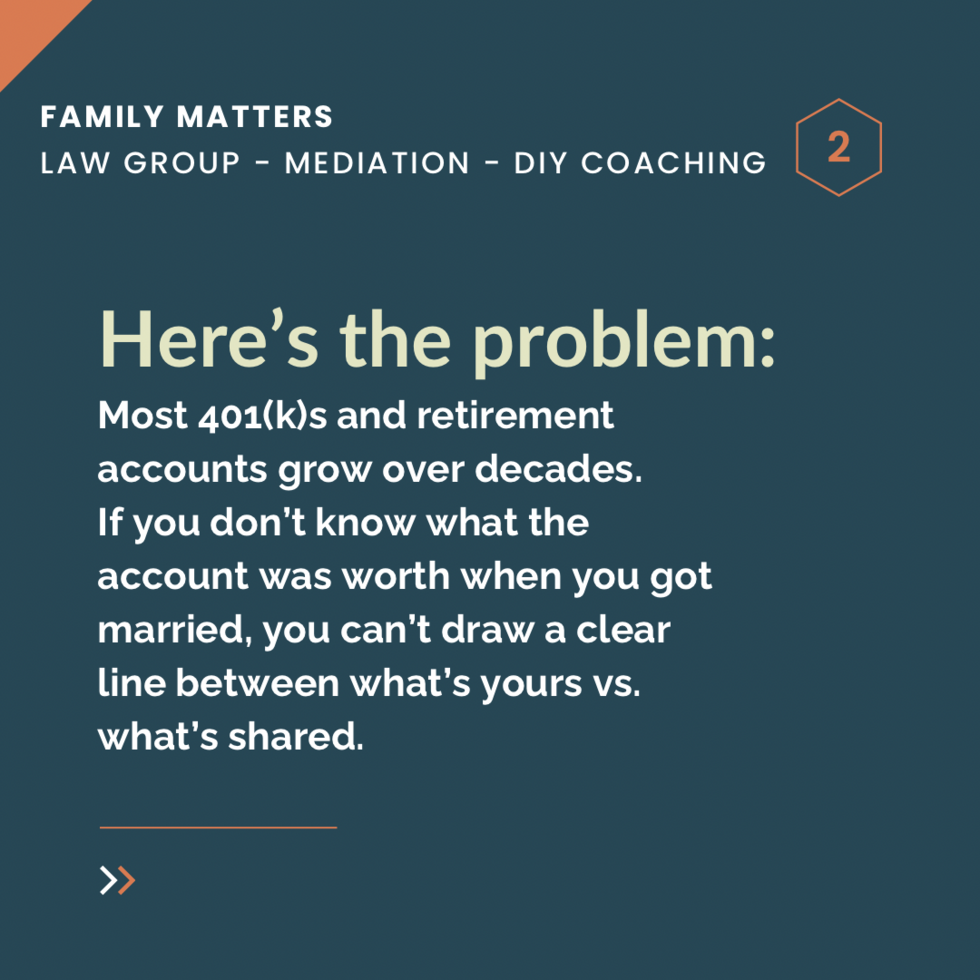
If you’re going through a divorce in Florida and your retirement account predates your marriage, the first step is usually to determine the value of the account on the date of marriage. That lets us draw a clear line between what’s premarital (yours) and what’s marital (shared). But what if those records are long gone? It happens more often than you’d think—and Florida courts have a way to deal with it.

🧮 When Records Are Missing, We Use the Coverture Fraction

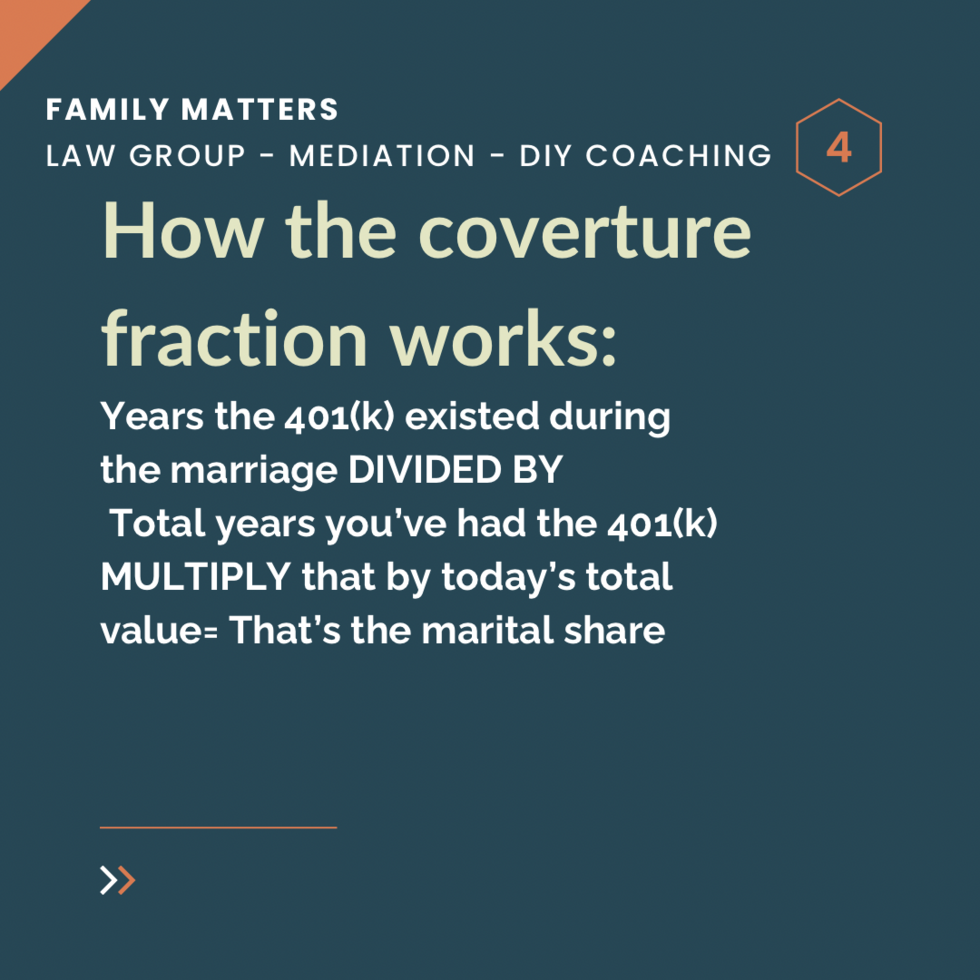
If you can’t prove the value of your 401(k) at the time of marriage, courts may apply what’s called a coverture fraction to estimate the marital share. It’s a way to approximate how much of the account should be treated as marital property—even without exact numbers. Here’s how it works:
  • Numerator: Years (or months) of the 401(k) during the marriage
  • Denominator: Total years (or months) of the 401(k)’s existence
  • Multiply that fraction by the current total value of the 401(k)
  • The result is the estimated marital portion subject to division

🔍 Real Example:

Let’s say you’ve had your 401(k) for 20 years, but were only married for 10. The court may determine that 10/20 = 50% of the total value is marital. So if the account is worth $200,000 today, $100,000 could be considered marital—even though no one knows the exact value on the wedding date.

⚠️ But Wait—It’s Not Always That Simple

The coverture method is an estimate, not a perfect science. There are a few things you should consider before assuming it’s the best or only option:
  • 📈 Did the account grow a lot before the marriage?
    You might be giving up more than you need to if you don’t at least try to trace those early contributions and growth.
  • 🛑 Was the marriage short but the account old?
    Using the coverture method could unfairly overstate the marital portion.
  • 👎 Was the other spouse barely contributing?
    Maybe the account grew from market gains, not ongoing effort—and that could matter.
If you’re the spouse trying to protect your retirement savings, the burden is usually on you to prove what portion is non-marital. And if you’re the spouse trying to claim part of the account, you need to be ready to show what portion was earned during the marriage. When exact numbers don’t exist, the court will rely on what’s most fair—but fair doesn’t always mean equal.

💡 Pro Tip from Family Matters Law Group, P.A.:

If you’re dealing with missing financial records or unclear account values, don’t panic. We’ve helped plenty of clients navigate this issue—whether by working with a forensic accountant, negotiating a fair coverture-based split, or raising creative arguments that account for unequal growth or investment risk. Sometimes, doing what’s equitable means adapting to what’s actually possible—and we know how to do both.

👣 What to Do Next:

  • If you’re in the early stages of divorce, ask for all retirement statements ASAP.
  • If you can’t locate old records, get a letter from the plan administrator confirming how far back records go.
  • Consider a flat-fee strategy session with our team to map out options and prepare for settlement or trial.
We offer legal representation, coaching, and unbundled document help across Florida—and we know how to break down complex financial questions in a way that makes sense. ✅ Bottom Line: If the premarital value of a 401(k) is missing, Florida courts often use a coverture fraction to determine the marital share. It’s not perfect, but it’s a practical solution when detailed records no longer exist. Whether you’re trying to protect what you earned or get your fair share, you don’t have to navigate this alone. 📲 Need help? Schedule a strategy session or explore our flat-fee options: 👉 https://www.familymatterslawgroup.com Or check out our DIY Legal education tools: 👉 https://diy-legal-by-family-matters-law-group.mn.co

Talk it through before you sign anything

Your intake goes straight to our team — start with a free consult or move straight ahead.

What No One Tells You About High-Conflict Divorce and Custody Battles in Florida

Florida Family Law

What No One Tells You About High-Conflict Divorce and Custody Battles in Florida

From out-of-state parental kidnapping to shady financial games and judge-specific rules—here are 5 things no one tells you about high-conflict custody battles in Florida family law.


What No One Tells You About High-Conflict Divorce and Custody Battles in Florida

Going through a divorce or custody dispute is hard enough when both parties are reasonable. But when emotions boil over, or one party refuses to play fair, things escalate quickly. As Florida family law attorneys, we see it all—and we want to prepare you for what most people don’t talk about. Here are five hard truths we wish more people knew about high-conflict family law cases in Florida:

1. “You’ll Never See Your Kid Again” — The Weaponization of Fear

It happens in our office all the time. A parent shows up, panicked after their ex threatened them:
“You’re never going to see your kid again.”
“You don’t need to know where we live.”
“You’re not getting a penny.”
These are fear tactics. They’re used to manipulate you during one of the most emotionally vulnerable moments in your life. People use threats when they feel out of control. And the end of a relationship—especially one involving children and shared finances—brings a lot of that. But here’s the reality: ✅ In Florida, without a court-ordered parenting plan, law enforcement won’t step in during parental disputes.
✅ There is a presumption of equal parental rights if the father is on the birth certificate—but this does not equal timesharing or enforceable visitation without a court order.
✅ You have to file in court to protect yourself—and your child. Don’t let fear make your legal decisions. Let facts and strategic action lead the way.

2. When Your Ex Leaves the State With the Child—You Need More Than a Court Order

Let’s say you’ve gone through the hard work of getting a Florida court order. You’ve done everything right. But now your ex has taken your child and moved to another state—like Tennessee. Now what? ⚠️ That Florida court order is not automatically enforceable in another state.
To have it recognized and enforced, you need to domesticate the order. That means filing it with the court in the other state (Tennessee, for example) and asking that court to give your Florida order the same force it had in Florida. Only then will that state enforce the order or issue a pick-up order, if necessary. This is one of the most misunderstood parts of interstate parenting disputes—and it delays reunification every day. If your ex takes your child across state lines, you must act fast.

3. Financial Lies Can Destroy a Fair Outcome—If You Let Them

We were in mediation recently with a client who had requested full financial disclosure from her spouse. What we got? Six months of bank statements—and that’s it. But those six months told a story:
💰 $13,000/month average income.
📄 A sworn financial affidavit claiming only $40,000/year. When we pointed out the inconsistency, the husband responded:
“Well, that was then. This is now.”
Sorry. That’s not how this works. In Florida, mandatory disclosure includes a full year of bank records, tax returns, pay stubs, and more. If the other party refuses to comply, your attorney can file:
  • A motion to compel
  • A motion for contempt
  • A request for sanctions or fees
Don’t settle in mediation based on lies. Demand the truth. If they won’t provide it, get the court involved.

4. Every Judge Has Their Own Rules—And You’re Expected to Know Them

Florida family court isn’t one-size-fits-all. Each judge has their own procedures, deadlines, and preferences. And they’re not always listed in plain sight. Example: One of our clients filed a temporary relocation motion, expecting a hearing within 30 days (as allowed by statute). But the judge’s division required that a special scheduling request be submitted within three days of filing—a fact buried in that judge’s procedures. Miss it? You’re not getting your hearing. To avoid costly delays:
✅ Always read your assigned judge’s divisional instructions.
✅ Don’t rely solely on general legal advice—ask what’s required in your courtroom.
✅ Hire attorneys who know the local system and judges.

5. Co-Parenting Is a Business. But Some Partners Don’t Pull Their Weight.

Let’s get one thing straight:
Shared parental responsibility means you both get equal input in major decisions.
It does not mean you both do 50% of the work. In many families, one parent handles school schedules, doctor’s appointments, and day-to-day care. The other may be distant, disorganized, or uninvolved—yet they still have equal say. Think of it like a business:
  • You’re 50/50 owners.
  • You may be the only one showing up for meetings.
  • But your co-owner still has voting rights.
This becomes a legal problem when:
  • One parent refuses to participate but blocks decisions.
  • Important medical or educational choices are stalled.
  • The child’s wellbeing is harmed.
In that case, the court can modify parental responsibility or appoint a tie-breaker. But it requires evidence and patience.

🧠 Bottom Line

High-conflict family law cases are brutal. They’re filled with fear, games, lies, and frustration. But you are not powerless—and you don’t have to figure it out alone. Whether it’s protecting your rights across state lines, enforcing parenting plans, or holding someone accountable for deception, we can help you take back control of your case and your life.

🔗 Internal Calls to Action:

Talk it through before you sign anything

Your intake goes straight to our team — start with a free consult or move straight ahead.

🚫 “Parental Kidnapping” in Florida? What It Really Means (and What to Do)

Florida Family Law

🚫 “Parental Kidnapping” in Florida? What It Really Means (and What to Do)

Is it parental kidnapping if the other parent won’t return your child? In Florida, not necessarily. Learn what counts as kidnapping, what doesn’t, and how to take action legally.

You’re panicked.
You can’t get ahold of your child.
The other parent won’t answer.
You’re ready to call the police. But they say:
“Sorry, we can’t help. This is a civil matter.”
And you’re left wondering—isn’t this parental kidnapping?! In Florida, not necessarily. Let’s break down what’s actually happening, and what you can do to protect your child.

❗ Parental Kidnapping Is a Legal Term—Not an Emotion

You may feel like your child is being kidnapped. And emotionally, that’s real. But legally, Florida only considers something “parental kidnapping” if:
  • A court-ordered parenting plan or custody order exists, and
  • One parent violates that order by taking, hiding, or refusing to return the child
  • There is intent to interfere with the other parent’s lawful time-sharing
In those cases, it may be a third-degree felony—or higher if there’s danger or out-of-state concealment.

👮‍♂️ Why Police Usually Won’t Help

Police need a court order to enforce custody. Even if both parents are on the birth certificate:
  • There is a presumption of parental rights for the father
  • But until there’s a parenting plan or order in place, those rights are not enforceable
So when a parent refuses to return a child, police usually cannot and will not intervene unless there’s:
  • An existing custody order being violated
  • A criminal concern (abuse, abandonment, endangerment)

📄 What to Do if There’s No Court Order

If you’ve never filed for divorce or paternity, and the other parent keeps the child or refuses to return them, the law sees this as a civil dispute. Here’s what you should do:
  1. File a Petition Immediately
    • For paternity (if never married)
    • For divorce with minor children (if married)
  2. Request Temporary or Emergency Relief
    • Ask the judge to enter a temporary parenting plan
    • Explain any safety concerns or history of withholding
  3. Document Everything
    • Texts, calls, DMs, previous agreements
    • Any efforts to locate or communicate with your child
  4. If There’s a Safety Concern
    • You can call DCF for a well-child check
    • Or file a verified emergency motion with the court

⚖️ What the Court Will Actually Do

If a court-ordered parenting plan does exist and the other parent is violating it, you can:
  • File a motion for contempt
  • Request make-up time
  • Ask for sanctions or attorney’s fees
  • In serious cases, seek modification of the plan or supervised time-sharing
Still—this is handled in family court, not criminal court the majority of the time.

🧠 Special Circumstances That Raise Red Flags

There are situations where this crosses the line into real danger: 🚨 If the parent is not on the birth certificate
🚨 If there’s no relationship with the child
🚨 If the child is taken out of state or hidden intentionally In these cases, you may have a valid claim for parental kidnapping under Florida criminal law—and law enforcement may get involved.

✅ Bottom Line

Parental kidnapping isn’t what most people think it is.
If there’s no court order, police usually won’t act.
If there is an order, your best path is family court—not jail time. Want to protect yourself?
Get a parenting plan in place before things spiral.

📲 Need Support?

We offer:
  • ✅ Flat-fee support
  • ✅ DIY Legal Coaching
  • ✅ Emergency Strategy Sessions
  • ✅ Full representation if needed
🔗 Start here with a strategy session

Talk it through before you sign anything

Your intake goes straight to our team — start with a free consult or move straight ahead.
✈ What Happens When a Florida Custody Order Crosses State Lines

Florida Family Law

✈ What Happens When a Florida Custody Order Crosses State Lines

When a Florida parent takes a child across state lines, your Florida custody order isn’t automatically enforceable. Learn how domestication works and when you’ll need it.


And Why “Domestication” Is the Key to Getting Your Child Back

 
When someone violates your Florida parenting plan or custody order by taking your child out of state—without your permission or the court’s—you may feel powerless.
  But here’s the truth: Florida custody orders do carry weight across state lines. You just have to take the right legal steps to get another state to recognize and enforce them.   Let’s break this down.    

❓What Happens When a Florida Custody Order Leaves the State?

  Florida court orders—including time-sharing schedules, parental responsibility rulings, and even pick-up orders—don’t automatically have legal effect in another state. That means: • Police in another state are not going to enforce a Florida order on their own. • A judge in another state is not going to jump in and act unless you ask them to and follow proper procedure.   That’s where domestication comes in.   ⸻  

🔑 What Is Domestication?

  Domestication is the legal process of registering your Florida court order in the new state—so that state’s courts and law enforcement can recognize and enforce it like one of their own.   Think of it like this: you’re telling the new state, “Hey, I already did the hard work in court. I just need you to honor this existing order.”   Once domesticated, your Florida custody order becomes enforceable—whether you’re trying to get your child returned, prevent unlawful relocation, or hold the other parent in contempt.   ⸻  

🧠 Real-Life Examples of When This Comes Up

  ✅ Example 1: Your Co-Parent Takes the Child and Moves to Tennessee Without Telling You   You have a Florida parenting plan with 50/50 time-sharing. One day, your ex doesn’t return your child after their week. You find out through social media they’ve moved to Chattanooga “for a fresh start.”   You call the police—who tell you they can’t do anything because it’s a civil matter and the order is from another state. → Solution: You file to domesticate your Florida order in Tennessee and request enforcement, which could include returning the child or a contempt finding.   ⸻   ✅ Example 2: You Have a Florida Pick-Up Order—but the Child Is Now in Georgia   Let’s say the court issued you a pick-up order—a specific court order authorizing law enforcement to recover your child. But the child has already been taken to Savannah, Georgia.   That pick-up order won’t be honored in Georgia until it’s registered there. → Solution: You quickly file to domesticate the Florida pick-up order in Georgia and coordinate with local law enforcement once it’s approved.   ⸻   ✅ Example 3: You’re Trying to Prevent Relocation to Another State   You have shared parental responsibility, and your co-parent needs court permission to relocate more than 50 miles. But they move to North Carolina anyway, claiming it was temporary.   Even though you have a Florida order saying relocation isn’t permitted without a hearing, North Carolina won’t do anything unless it’s domesticated. → Solution: You file the Florida order in North Carolina and pursue enforcement for violation of the parenting plan.   ⸻  

📋 What You’ll Need to Domesticate a Florida Custody Order

  Each state has its own rules, but most require: • A certified copy of the Florida order • An affidavit or petition to register the order • Sometimes, notice to the other party and a short hearing • Filing fees   In urgent situations—like when you’re trying to recover a child wrongfully withheld—time is critical. You may also be able to file an emergency motion in Florida and start the domestication process in the other state simultaneously.   ⸻  

🛠 How We Help at Family Matters Law Group

  This isn’t just theory. We help parents in these situations all the time. Whether you’re trying to enforce your rights from Florida, or your child was taken out of state, we can guide you through: • Filing emergency motions in Florida • Coordinating with the other state for domestication • Drafting enforcement or pick-up requests • Navigating police and court procedures across state lines • Working with lawyers or agencies in the other state if needed   We also offer DIY Legal Coaching and limited scope representation if you’re trying to handle the bulk of the process yourself but need legal guidance to do it right.  

Your Florida custody order does matter in other states—but it’s not automatic.

If your co-parent takes your child out of Florida or refuses to return them, don’t panic. Domesticate the order, and take the next step.   ⸻   • Need help with interstate custody enforcement? Start here: Get Started with Legal Help • Have a court order but don’t know what to do next? Book a strategy session.          

Talk it through before you sign anything

Your intake goes straight to our team — start with a free consult or move straight ahead.
Why Am I in Child Support Court If No One Filed?

Florida Family Law

Why Am I in Child Support Court If No One Filed?

You can end up in child support court even if the other parent didn’t file — here’s how Florida’s Department of Revenue steps in when government benefits are used.

Why You’re in Child Support Court Even If Nobody Filed

If you’ve received notice that you’re expected in child support court, but the other parent says, “I didn’t ask for this,” you’re probably confused. You’re not alone — this is one of the most misunderstood areas of Florida family law. So what’s really going on?

🚨 When the State Steps In

In Florida, if a parent applies for or receives government assistance — like Medicaid, SNAP (food stamps), or TANF (cash assistance) — they are automatically consenting to the state (through the Department of Revenue) opening a child support case. That’s because the state wants to recover some of the money it’s paying out.

🖊️ The Fine Print in Public Benefits

When applying for benefits, there’s language — often buried in the application — that says the recipient agrees to cooperate with child support enforcement. Most people don’t realize that means:
  • The Department of Revenue (DOR) becomes the one pursuing support
  • The case isn’t really “hers” anymore
  • The parent receiving benefits can’t choose to drop it or make private deals
Even if the other parent says, “I’m not asking for child support,” the DOR is asking for it — because they represent the State of Florida.

⚖️ You Can’t Just Opt Out

Once the DOR is involved, you don’t get to:
  • Avoid court because you two “have an agreement”
  • Pay support informally without a court order
  • Stop the process just because both parents agree
The state has a vested interest in getting reimbursed for benefits given to the child, and that often means pursuing child support orders even against the wishes of the other parent.

👨‍👩‍👧 What You Can Do

If you’re on the receiving end of this situation — especially if you’re being told you owe back child support — you do have rights. You may be able to:
  • Request a hearing
  • Challenge the amount owed
  • Ask for a modification if your circumstances have changed
But you’ll need to take formal legal steps — and fast. The system is not always forgiving when it comes to deadlines and defaults.
🚨 Bottom Line:
If you’re in child support court and confused about how you got there — chances are, the Department of Revenue filed on behalf of the state because of benefits used for the child. This happens even when the other parent doesn’t want child support. Don’t ignore it — get legal advice and protect yourself.
Internal Calls to Action:
✅ Book a strategy session with our team
✅ Join our free DIY Legal Group
✅ Learn about our child support resources
Tags: child support, Florida family law, DOR, public assistance, Medicaid, SNAP, parenting law, legal help Florida

Talk it through before you sign anything

Your intake goes straight to our team — start with a free consult or move straight ahead.